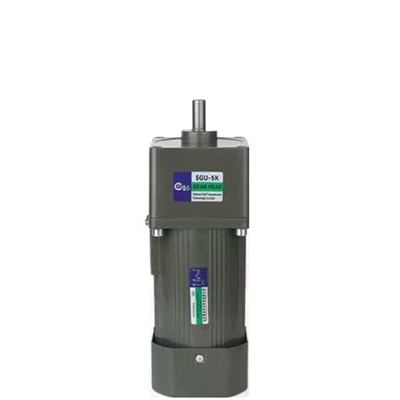
Hey there! As a supplier of Spindle Servo Motors, I often get asked about the dynamic response speed of these motors. It's a crucial aspect, especially for industries that rely on high - precision and high - speed operations. So, let's dive right in and explore what the dynamic response speed of a spindle servo motor is all about.
First off, what exactly is a Spindle Servo Motor? A Spindle Servo Motor is a type of motor that is designed to control the position, speed, and torque of a spindle. Spindles are used in a wide range of applications, from CNC machining centers to robotics. These motors are known for their high precision and ability to respond quickly to changes in commands.
The dynamic response speed of a spindle servo motor refers to how fast the motor can adjust its speed, torque, or position in response to a change in the input signal. In simpler terms, it's the motor's ability to "catch up" when there's a new demand. For example, if you're using a spindle servo motor in a CNC machine and you suddenly need to change the cutting speed, the motor should be able to adjust its rotation speed rapidly to meet the new requirement.
There are a few key factors that affect the dynamic response speed of a spindle servo motor. One of the most important ones is the motor's inertia. Inertia is a measure of an object's resistance to changes in its motion. A motor with high inertia will take longer to speed up or slow down compared to a motor with low inertia. So, if you need a motor with a fast dynamic response speed, you'll want to look for one with a relatively low inertia.
Another factor is the motor's torque - to - inertia ratio. This ratio indicates how much torque the motor can produce relative to its inertia. A higher torque - to - inertia ratio means that the motor can accelerate or decelerate more quickly. In other words, it can respond faster to changes in the input signal. For applications where quick changes in speed or position are required, a motor with a high torque - to - inertia ratio is essential.
The control system of the spindle servo motor also plays a significant role in its dynamic response speed. A good control system can accurately monitor the motor's performance and make real - time adjustments to ensure that it responds quickly to changes in the input. Modern control systems often use advanced algorithms and feedback mechanisms to optimize the motor's performance. For example, they can use sensors to measure the motor's speed, position, and torque, and then adjust the power supply accordingly.
Let's talk about the benefits of having a spindle servo motor with a fast dynamic response speed. In manufacturing applications, a fast - responding motor can significantly improve productivity. For instance, in a CNC machining center, a motor that can quickly adjust its speed and position can reduce the time it takes to complete a machining operation. This means that more parts can be produced in a shorter period, leading to higher output and potentially lower costs.
In addition, a fast dynamic response speed can also improve the quality of the finished product. In applications where precision is crucial, such as in the production of high - end electronics or medical devices, a motor that can accurately and quickly respond to changes can ensure that the machining or assembly process is carried out with high precision. This can result in fewer defects and higher - quality products.
Now, let's compare spindle servo motors with Permanent Magnet Motor Synchronous. Permanent magnet synchronous motors are also known for their high efficiency and precision. However, when it comes to dynamic response speed, spindle servo motors often have an edge. Spindle servo motors are specifically designed to handle rapid changes in speed and position, making them ideal for applications where quick response is required.
In some cases, the choice between a spindle servo motor and a permanent magnet synchronous motor depends on the specific requirements of the application. If you need a motor for a continuous - speed operation with relatively stable conditions, a permanent magnet synchronous motor might be a good choice. But if your application involves frequent changes in speed, torque, or position, a spindle servo motor is likely to be the better option.
So, if you're in the market for a spindle servo motor, it's important to consider the dynamic response speed along with other factors such as power, torque, and efficiency. A motor with a fast dynamic response speed can offer significant advantages in terms of productivity and product quality.
If you're interested in learning more about our Spindle Servo Motors or have any questions regarding the dynamic response speed or other features, don't hesitate to reach out. We're here to help you find the perfect motor for your specific application. Whether you're in the manufacturing, robotics, or any other industry that requires high - performance motors, we can provide you with the right solution. Contact us today to start a discussion about your needs and how our Spindle Servo Motors can meet them.

References
- Dorf, R. C., & Bishop, R. H. (2016). Modern Control Systems. Pearson.
- Krause, P. C., Wasynczuk, O., Sudhoff, S. D., & Pekarek, S. D. (2013). Analysis of Electric Machinery and Drive Systems. Wiley.