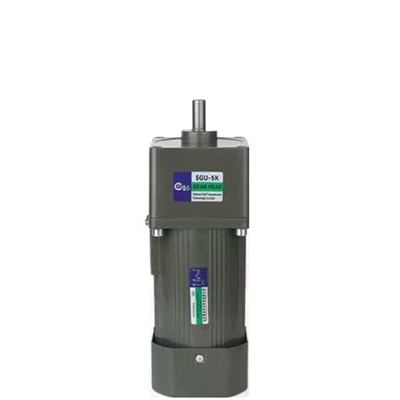
Hey there! As a supplier of 400W AC Gear Motors, I often get asked about the current consumption of these motors. It's a crucial question, especially for those looking to optimize their energy usage or design systems with specific power requirements. So, let's dive right in and explore what the current consumption of a 400W AC Gear Motor is all about.
First off, let's understand the basics. Power (P) in an electrical circuit is calculated using the formula P = VI, where V is the voltage and I is the current. In the case of a 400W AC Gear Motor, the power rating is 400 watts. However, the current consumption isn't a fixed value; it depends on the voltage at which the motor operates.
Most commonly, AC gear motors are designed to work with standard household or industrial voltages. In many regions, the standard voltage is 220V. If we use the power formula and solve for current (I = P/V), for a 400W motor operating at 220V, the current consumption would be approximately I = 400W / 220V ≈ 1.82 amps. But it's important to note that this is a theoretical calculation based on ideal conditions.
In real - world scenarios, things are a bit more complex. Motors have an efficiency factor. No motor can convert 100% of the electrical energy it consumes into mechanical energy. There are losses due to factors like heat generation, friction in the gears, and electrical resistance in the windings. So, the actual current drawn by the motor will be higher than the theoretical value.
Let's say the efficiency of our 400W AC Gear Motor is around 80%. To deliver 400W of mechanical power, the input electrical power needs to be higher. We can calculate the input power (Pin) using the formula Pin = Pout / efficiency, where Pout is the output mechanical power. So, Pin = 400W / 0.8 = 500W. Now, if we recalculate the current at 220V, I = 500W / 220V ≈ 2.27 amps.
Another factor that affects current consumption is the load on the motor. When the motor is running without a load (idle), it consumes less current compared to when it's under full load. For example, an idle 400W AC Gear Motor might draw only about 30 - 50% of the current it would draw under full load. As the load on the motor increases, the motor has to work harder, and thus it draws more current.
If you're considering a different voltage, say a 200W AC Gear Motor or a different power - rated motor, the calculations change accordingly. For instance, if you have a 200W motor operating at 220V, using the theoretical formula I = P/V, the current would be I = 200W / 220V ≈ 0.91 amps. And again, factoring in efficiency and load, the actual value will vary.
Now, let's talk a bit about why understanding current consumption matters. For businesses, it directly impacts energy costs. A motor that consumes more current will cost more to run over time. Also, in electrical system design, knowing the current draw is essential for sizing the electrical components such as circuit breakers, fuses, and wiring. If the current draw is underestimated, it can lead to overheating of components and potential safety hazards.
As a supplier of 400W AC Gear Motors, I can tell you that we offer a range of high - quality motors. Our 400W AC Gear Motors are designed with efficiency in mind. We use advanced materials and manufacturing techniques to reduce losses and improve the overall performance of the motors.
If you're in the market for a reliable 220V AC Gear Motor, we've got you covered. Our 220V AC Gear Motor models are built to last and provide consistent performance. Whether you're using it for industrial machinery, conveyor systems, or any other application, you can trust our motors to meet your needs.
When it comes to choosing the right motor, it's not just about the power rating and current consumption. You also need to consider factors like speed, torque, and the type of gearbox. Our team of experts is always here to help you make the right choice. We can provide detailed technical specifications and answer any questions you might have.
So, if you think our 400W AC Gear Motors could be a good fit for your project, don't hesitate to reach out. We're open to discussing your requirements, providing quotes, and even arranging product samples if needed. Whether you're a small business or a large industrial enterprise, we're committed to providing you with the best products and services.


Let's start a conversation and see how we can work together to meet your motor needs. Whether it's for a new project or to replace an existing motor, we're confident that our 400W AC Gear Motors will exceed your expectations.
References:
- Electrical Engineering Fundamentals textbooks
- Manufacturer's specifications for AC Gear Motors