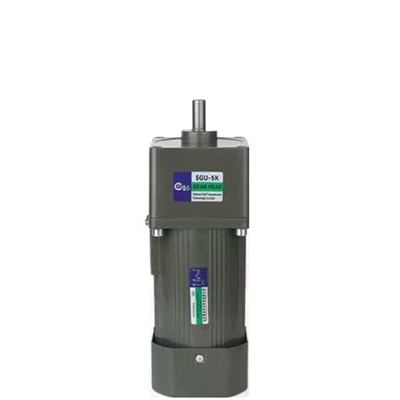
As a supplier of IE2 Electric Motors, I'm often asked about the speed regulation characteristics of these motors. In this blog post, I'll delve into the details of IE2 Electric Motors' speed regulation, comparing them with other types of motors and highlighting their unique features.
Basics of IE2 Electric Motors
IE2 Electric Motors are part of the international energy - efficiency classification system for motors. They are known for their relatively high energy efficiency compared to older motor models. These motors typically operate on the principle of electromagnetic induction, where a rotating magnetic field is created in the stator, which in turn induces currents in the rotor, causing it to rotate.
Speed Regulation Mechanisms
The speed regulation of IE2 Electric Motors is a crucial aspect of their performance. There are several factors that influence the speed of these motors, and different methods can be used to regulate it.
Slip and Speed Relationship
In an induction motor like the IE2, the speed of the motor is related to the slip. Slip is defined as the difference between the synchronous speed ($N_s$) and the actual rotor speed ($N$), expressed as a percentage. The synchronous speed is determined by the frequency of the power supply ($f$) and the number of poles ($p$) of the motor, according to the formula $N_s=\frac{120f}{p}$.
For example, in a 50 - Hz power supply system, a 4 - pole motor has a synchronous speed of $N_s=\frac{120\times50}{4}=1500$ rpm. The actual rotor speed will be slightly less than the synchronous speed due to slip. The slip in IE2 motors is typically in the range of 2 - 5% depending on the load. When the load on the motor increases, the slip also increases, causing the rotor speed to decrease.
Voltage and Frequency Control
One of the most common methods of speed regulation for IE2 Electric Motors is through voltage and frequency control. By adjusting the voltage and frequency supplied to the motor, the speed can be changed. This is often achieved using a variable - frequency drive (VFD).
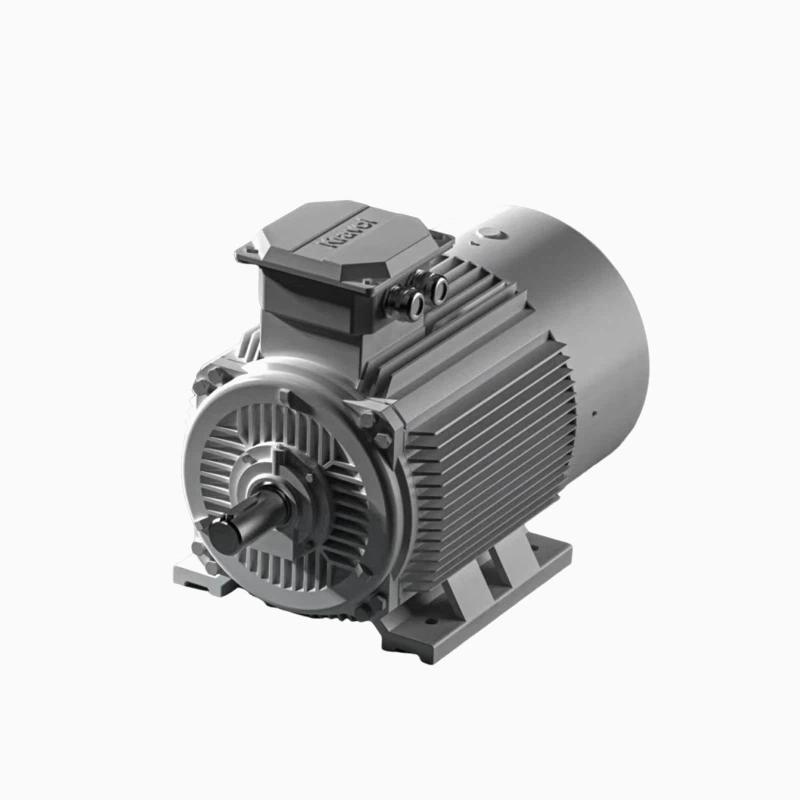

A VFD can vary the frequency of the power supply to the motor. As the frequency is decreased, the synchronous speed of the motor also decreases, and the actual rotor speed follows suit. At the same time, the voltage is adjusted proportionally to maintain the magnetic flux in the motor at an appropriate level. This method allows for smooth and precise speed control over a wide range.
Pole - Changing Method
Another way to regulate the speed of an IE2 Electric Motor is by changing the number of poles. Some IE2 motors are designed with multiple sets of windings that can be connected in different configurations to change the number of poles. For example, a motor can be designed to operate as a 4 - pole or an 8 - pole motor. When the number of poles is increased from 4 to 8, the synchronous speed is halved. This method provides discrete speed changes rather than continuous speed control.
Comparison with Other Motors
IE4 Electric Motor
When comparing IE2 Electric Motors with IE4 Electric Motor, IE4 motors generally have even higher energy efficiency. In terms of speed regulation, both types of motors can use similar methods such as VFD control. However, IE4 motors may be more optimized for high - precision speed control applications due to their advanced design and better - quality materials. They may also have lower slip, which means more stable speed under load.
Y2 Three Phase Motor
The Y2 Three Phase Motor is an older type of three - phase motor. Compared to IE2 motors, Y2 motors usually have lower energy efficiency. In terms of speed regulation, the basic principles are similar, but IE2 motors may offer better performance in terms of speed stability and control accuracy. Y2 motors may have a higher slip and less precise speed regulation capabilities, especially when using methods like VFD control.
IE3 Electric Motor
IE3 Electric Motor is more energy - efficient than IE2 motors. In terms of speed regulation, both types can use the same speed - control methods. However, IE3 motors may have better thermal management and more stable performance during speed regulation, which can lead to longer motor life and more reliable operation.
Advantages of IE2 Electric Motors in Speed Regulation
- Cost - Effectiveness: IE2 Electric Motors offer a good balance between cost and performance in terms of speed regulation. Compared to higher - efficiency motors like IE4, they are more affordable, making them a popular choice for many industrial applications where precise speed control is required but the budget is limited.
- Wide Range of Applications: The speed regulation characteristics of IE2 motors make them suitable for a wide range of applications. They can be used in conveyor systems, pumps, fans, and other equipment where different speeds are needed depending on the operating conditions.
- Compatibility with Existing Systems: These motors are often compatible with existing control systems. They can be easily integrated with VFDs and other speed - control devices, which is an advantage for industries looking to upgrade their motor systems without significant changes to the overall infrastructure.
Considerations for Speed Regulation
When using IE2 Electric Motors for speed regulation, there are several considerations to keep in mind.
- Load Characteristics: The load on the motor has a significant impact on speed regulation. Different types of loads, such as constant - torque loads, variable - torque loads, and constant - power loads, require different speed - control strategies. For example, in a constant - torque load like a conveyor belt, the motor needs to maintain a relatively constant torque over a wide speed range.
- Thermal Management: Speed regulation can affect the heat generation in the motor. When the motor operates at low speeds for extended periods, the cooling effect may be reduced, leading to overheating. Proper thermal management, such as using external cooling fans or heat sinks, may be required to ensure the motor's reliability.
- Control System Compatibility: The speed - control device, such as a VFD, needs to be compatible with the IE2 motor. The VFD should be able to provide the appropriate voltage and frequency signals and have the necessary protection features to prevent damage to the motor.
Conclusion
In conclusion, the speed regulation characteristics of IE2 Electric Motors are an important aspect of their performance. Through methods such as slip control, voltage and frequency control, and pole - changing, these motors can achieve a certain degree of speed regulation. Compared to other motors like IE4, Y2, and IE3, IE2 motors offer a cost - effective solution for many industrial applications.
If you are interested in learning more about IE2 Electric Motors or are considering purchasing them for your specific application, I encourage you to contact us for a detailed discussion. We can provide you with more information on the speed regulation capabilities of our motors and help you select the most suitable motor for your needs.
References
- Chapman, S. J. (2012). Electric Machinery Fundamentals. McGraw - Hill Education.
- Fitzgerald, A. E., Kingsley, C., Jr., & Umans, S. D. (2003). Electric Machinery. McGraw - Hill Education.