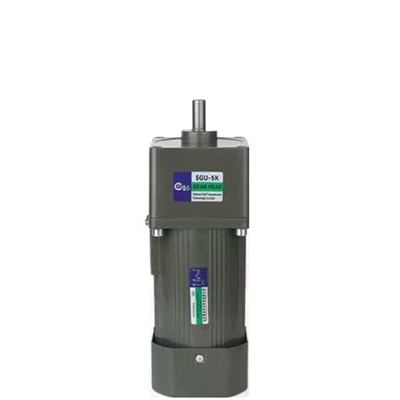
Hey there! As a gear motor supplier, I often get asked about different aspects of gear motors. One question that pops up quite a bit is, "What is the static torque of a gear motor?" Well, let's dive right into it and break it down in a way that's easy to understand.
First off, let's talk about what a gear motor is. A gear motor is a combination of an electric motor and a gearbox. The gearbox is used to reduce the speed of the motor and increase the torque. This makes the gear motor more suitable for applications where high torque is required at low speeds. For example, you might find gear motors in conveyor systems, industrial machinery, and even some home appliances.
Now, let's get to the main topic - static torque. Static torque is the amount of torque that a gear motor can produce when it's not moving, or in a stationary position. In other words, it's the maximum amount of force that the motor can apply to a load without causing it to rotate. This is an important specification because it tells you how much weight or resistance the motor can handle when it's starting up or holding a position.
Think of it like trying to turn a stubborn bolt with a wrench. If the bolt is really tight, you need to apply a lot of force to get it moving. The amount of force you need to apply before the bolt starts to turn is similar to the static torque of a gear motor. Once the bolt starts moving, you might not need to apply as much force to keep it turning.


There are a few factors that can affect the static torque of a gear motor. One of the main factors is the gear ratio. The gear ratio is the ratio of the number of teeth on the input gear to the number of teeth on the output gear. A higher gear ratio means that the motor will have more torque, but it will also run at a lower speed. For example, a gear motor with a gear ratio of 10:1 will have 10 times more torque than a motor with a gear ratio of 1:1, but it will also run 10 times slower.
Another factor that can affect static torque is the type of motor. Different types of motors, such as DC motors and AC motors, have different torque characteristics. DC motors are known for their high starting torque, which means they can produce a lot of torque when they're starting up. AC motors, on the other hand, typically have a lower starting torque but can run at a more constant speed.
The size and design of the gearbox also play a role in determining the static torque. A larger gearbox with more gears will generally be able to handle more torque than a smaller gearbox. The quality of the gears and the lubrication used in the gearbox can also affect the performance of the motor.
So, why is static torque important? Well, if you're using a gear motor in an application where it needs to hold a load in place or start up under a heavy load, you need to make sure that the motor has enough static torque to handle the job. If the static torque is too low, the motor might not be able to start the load or might stall under the weight.
For example, let's say you're using a gear motor to lift a heavy object. If the static torque of the motor is too low, it might not be able to lift the object at all. On the other hand, if the static torque is too high, you might be using a motor that's more powerful than you need, which can lead to higher energy consumption and costs.
As a gear motor supplier, we offer a wide range of gear motors with different static torque ratings to meet the needs of different applications. For example, our 200W AC Gear Motor is a great option for applications that require a moderate amount of torque. It has a reliable performance and is suitable for a variety of industrial and commercial uses.
If you need a gear motor with a higher torque, our Gear Reduction Motor might be the right choice for you. This motor has a high gear ratio, which means it can produce a lot of torque at a low speed. It's perfect for applications where you need to move heavy loads or hold a position.
And if you're looking for a gear motor that runs on 220V AC power, our 220V AC Gear Motor is a great option. It's designed to be energy-efficient and reliable, and it can handle a variety of loads.
When choosing a gear motor, it's important to consider the static torque requirements of your application. You should also look at other factors, such as the speed, power consumption, and durability of the motor. If you're not sure which motor is right for you, our team of experts is always here to help. We can provide you with technical advice and recommendations based on your specific needs.
In conclusion, the static torque of a gear motor is an important specification that tells you how much force the motor can apply to a load when it's not moving. It's affected by factors such as the gear ratio, the type of motor, and the design of the gearbox. As a gear motor supplier, we offer a wide range of motors with different static torque ratings to meet the needs of different applications. If you're in the market for a gear motor, don't hesitate to contact us to discuss your requirements and find the perfect motor for your project.
References
- "Electric Motors and Drives: Fundamentals, Types and Applications" by Austin Hughes and Bill Drury
- "Mechanical Design of Machine Elements and Machines: A Failure Prevention Perspective" by Robert L. Norton