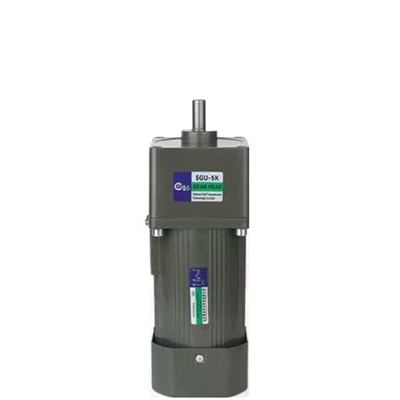
As a supplier of 400W AC gear motors, I often get asked about the starting torque of these motors. Starting torque is a crucial parameter when it comes to the performance and application of an AC gear motor. In this blog post, I'll delve into what starting torque is, how it relates to a 400W AC gear motor, and why it matters in various industrial and commercial applications.
Understanding Starting Torque
Torque is the rotational force that causes an object to rotate around an axis. In the context of an AC gear motor, torque is what enables the motor to start moving the load connected to it. Starting torque, specifically, is the torque produced by the motor at the instant it starts from rest. It is the force that overcomes the inertia of the load and gets the system in motion.
The starting torque of a motor is typically higher than its running torque. This is because when a motor is at rest, there is a significant amount of static friction and inertia that needs to be overcome to start the rotation. Once the motor is up and running, the dynamic friction is usually lower, and the motor can maintain the rotation with a lower torque.
Factors Affecting the Starting Torque of a 400W AC Gear Motor
Several factors influence the starting torque of a 400W AC gear motor. These include the motor design, the type of gear reduction used, and the electrical characteristics of the motor.
Motor Design
The design of the motor plays a significant role in determining its starting torque. Motors with a high starting torque are often designed with a larger number of turns in the stator windings. This increases the magnetic field strength, which in turn increases the torque produced by the motor. Additionally, the shape and size of the rotor can also affect the starting torque. A rotor with a larger diameter or a higher mass will generally have a higher inertia, which requires more torque to start rotating.
Gear Reduction
Gear reduction is another important factor that affects the starting torque of a 400W AC gear motor. A gear reduction system is used to increase the torque output of the motor while reducing its speed. By using a gearbox, the motor can produce a higher torque at the output shaft than it would be able to produce on its own. There are different types of gear reduction systems available, such as Gear Reduction Motor and Worm Gear Reduction Motor. Each type of gear reduction system has its own characteristics and advantages, and the choice of gear reduction system will depend on the specific application requirements.
Electrical Characteristics
The electrical characteristics of the motor, such as the voltage, frequency, and phase, also affect the starting torque. A higher voltage or frequency will generally result in a higher starting torque. Additionally, the type of motor control used, such as direct-on-line (DOL) starting or soft starting, can also affect the starting torque. DOL starting provides the full voltage to the motor at the instant of starting, which results in a high starting torque. However, this can also cause a high inrush current, which can damage the motor and other electrical components. Soft starting, on the other hand, gradually increases the voltage to the motor, which reduces the inrush current and the starting torque.
Calculating the Starting Torque of a 400W AC Gear Motor
Calculating the starting torque of a 400W AC gear motor can be a complex process, as it depends on several factors. However, there are some general formulas and guidelines that can be used to estimate the starting torque.
The starting torque of a motor can be calculated using the following formula:
[ T_{start} = \frac{P}{\omega} \times k ]
where ( T_{start} ) is the starting torque, ( P ) is the power of the motor, ( \omega ) is the angular velocity of the motor, and ( k ) is a factor that takes into account the motor design and the load characteristics.


The angular velocity of the motor can be calculated using the following formula:
[ \omega = \frac{2\pi n}{60} ]
where ( n ) is the speed of the motor in revolutions per minute (RPM).
The factor ( k ) is typically between 1.5 and 3, depending on the motor design and the load characteristics. A higher value of ( k ) indicates a higher starting torque.
Importance of Starting Torque in Different Applications
The starting torque of a 400W AC gear motor is an important consideration in various industrial and commercial applications. Here are some examples:
Conveyor Systems
In conveyor systems, the starting torque is crucial for starting the movement of the conveyor belt and the load on it. A motor with a high starting torque is required to overcome the static friction and inertia of the conveyor belt and the load. If the starting torque is too low, the conveyor belt may not start moving, or it may start moving slowly and cause the load to accumulate at the starting point.
Mixers and Agitators
Mixers and agitators are used to mix and blend different materials in various industries. The starting torque is important in these applications to overcome the resistance of the materials being mixed. A motor with a high starting torque is required to start the rotation of the mixer or agitator and to maintain the mixing process.
Machine Tools
In machine tools, such as lathes and milling machines, the starting torque is important for starting the rotation of the cutting tool and the workpiece. A motor with a high starting torque is required to overcome the inertia of the cutting tool and the workpiece and to start the machining process.
Comparison with a 200W AC Gear Motor
When comparing a 400W AC gear motor with a 200W AC Gear Motor, the starting torque of the 400W motor is generally higher. This is because the 400W motor has a higher power output, which allows it to produce more torque. However, the actual starting torque will also depend on the motor design, the type of gear reduction used, and the load characteristics.
In some applications, a 200W AC gear motor may be sufficient if the load is relatively light and the starting torque requirements are not very high. However, for applications with a heavy load or a high starting torque requirement, a 400W AC gear motor is usually a better choice.
Conclusion
In conclusion, the starting torque of a 400W AC gear motor is an important parameter that affects its performance and application. It is influenced by several factors, including the motor design, the type of gear reduction used, and the electrical characteristics of the motor. Understanding the starting torque requirements of your application is crucial for selecting the right motor.
If you are in the market for a 400W AC gear motor or have any questions about starting torque, feel free to contact us for more information and to discuss your specific requirements. We are a leading supplier of high-quality AC gear motors and can provide you with the best solutions for your applications.
References
- Electric Machinery Fundamentals by Stephen J. Chapman
- Motor and Drive Technology Handbook by Paul C. Krause, Oleg Wasynczuk, and Scott D. Sudhoff