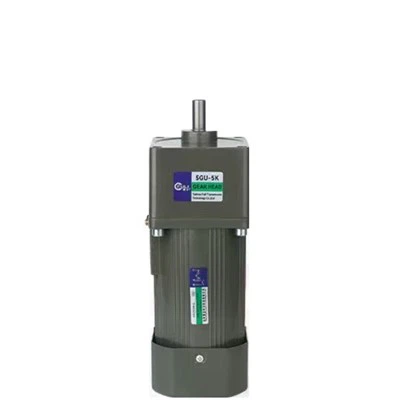
As a supplier of 220V AC Gear Motors, I often encounter questions from customers about the mechanical efficiency of these motors. Understanding the mechanical efficiency of a 220V AC Gear Motor is crucial for both manufacturers and end - users, as it directly impacts the performance, energy consumption, and overall cost - effectiveness of the equipment in which the motor is used.
What is Mechanical Efficiency?
Mechanical efficiency (η) is a measure of how effectively a machine converts input power into useful output power. In the context of a 220V AC Gear Motor, the input power is the electrical power supplied to the motor, and the output power is the mechanical power delivered by the motor shaft. The formula for mechanical efficiency is given by:
[ \eta=\frac{P_{out}}{P_{in}}\times100% ]
where (P_{out}) is the output power and (P_{in}) is the input power.
The input power (P_{in}) can be calculated using the formula (P_{in} = VI\cos\varphi), where (V = 220V) is the voltage, (I) is the current drawn by the motor, and (\cos\varphi) is the power factor. The output power (P_{out}) is typically measured in terms of torque ((T)) and rotational speed ((\omega)) using the formula (P_{out}=T\omega).
Factors Affecting the Mechanical Efficiency of 220V AC Gear Motors
1. Gear Design and Quality
The type of gears used in the gear motor has a significant impact on its efficiency. For example, Worm Gear Reduction Motor often have lower efficiencies compared to other types of gear systems. This is because worm gears involve a sliding action between the teeth, which generates more friction and heat. On the other hand, helical gears or spur gears can offer higher efficiencies as they have a more rolling - like contact between the teeth, reducing friction.
The quality of the gears also matters. High - precision gears with proper tooth profiles, surface finishes, and material properties can minimize power losses due to friction and wear. Gears made from high - strength and low - friction materials can improve the overall efficiency of the motor.
2. Motor Design and Construction
The design of the AC motor itself affects its efficiency. The magnetic circuit design, the number of poles, and the winding configuration all play a role. Motors with well - designed magnetic circuits can reduce magnetic losses, such as hysteresis and eddy - current losses. Additionally, the quality of the electrical insulation and the copper windings can impact the electrical resistance and, consequently, the power losses in the motor.
3. Lubrication
Proper lubrication is essential for reducing friction between the moving parts of the gear motor. A high - quality lubricant can form a thin film between the gear teeth and other contact surfaces, reducing wear and heat generation. Insufficient or improper lubrication can lead to increased friction, which in turn reduces the mechanical efficiency of the motor.
4. Load Conditions
The mechanical efficiency of a 220V AC Gear Motor can vary depending on the load it is operating under. Motors are typically designed to operate at their maximum efficiency within a certain load range. When the motor is under - loaded or over - loaded, its efficiency may decrease. For example, at very light loads, the fixed losses in the motor (such as core losses) become a relatively larger proportion of the total input power, reducing the overall efficiency.


Measuring the Mechanical Efficiency of 220V AC Gear Motors
To measure the mechanical efficiency of a 220V AC Gear Motor, we need to measure both the input power and the output power.
The input power can be measured using a power meter, which can accurately measure the voltage, current, and power factor of the motor. The output power can be measured using a dynamometer, which can measure the torque and rotational speed of the motor shaft. By dividing the measured output power by the measured input power and multiplying by 100%, we can obtain the mechanical efficiency of the motor.
Typical Efficiency Ranges of 220V AC Gear Motors
The mechanical efficiency of 220V AC Gear Motors can vary widely depending on the factors mentioned above. In general, the efficiency of a well - designed and properly maintained gear motor can range from 60% to 90%.
For example, Gear Reduction Motor with high - quality spur or helical gears may achieve efficiencies in the range of 80% - 90%. However, Worm Gear Reduction Motor may have efficiencies in the range of 60% - 70% due to the higher friction associated with the worm - gear design.
Importance of High - Efficiency 220V AC Gear Motors
1. Energy Savings
High - efficiency gear motors consume less electrical energy to produce the same amount of mechanical power. This can result in significant cost savings over the lifetime of the motor, especially in applications where the motor operates continuously or for long periods.
2. Reduced Heat Generation
Higher efficiency means less power is wasted as heat. Reduced heat generation can extend the lifespan of the motor and its components, as excessive heat can cause insulation breakdown, lubricant degradation, and mechanical wear.
3. Environmental Benefits
Using high - efficiency motors reduces the overall energy consumption, which in turn reduces the demand for electricity generation. This can have a positive impact on the environment by reducing greenhouse gas emissions associated with power generation.
Our 220V AC Gear Motor Offerings
As a supplier, we offer a wide range of 220V AC Gear Motors, including 200W AC Gear Motor. Our motors are designed with high - quality components and advanced manufacturing techniques to ensure high mechanical efficiency. We use precision - machined gears, high - grade electrical materials, and proper lubrication to minimize power losses and maximize performance.
We understand that different applications have different requirements, and we can provide customized solutions to meet your specific needs. Whether you need a motor with high torque, high speed, or a specific efficiency level, our team of experts can work with you to select the most suitable motor for your application.
Contact Us for Purchasing and Negotiation
If you are interested in our 220V AC Gear Motors or have any questions about their mechanical efficiency, performance, or application, we encourage you to contact us. Our sales team is ready to assist you in selecting the right motor for your needs and negotiating the best terms for your purchase.
References
- Chapman, S. J. (2012). Electric Machinery Fundamentals. McGraw - Hill.
- Fitzgerald, A. E., Kingsley, C., & Umans, S. D. (2003). Electric Machinery. McGraw - Hill.
- Dudley, D. W. (1994). Gear Handbook: Design, Manufacturing, and Application. McGraw - Hill.