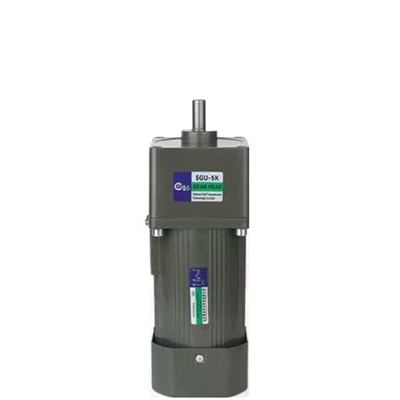
As a supplier of 400W AC Gear Motors, I often get asked about the load capacity of these motors. Understanding the load capacity is crucial for any application that involves the use of a gear motor, as it determines the motor's ability to perform under different working conditions. In this blog post, I'll delve into what load capacity means for a 400W AC Gear Motor, the factors that influence it, and how to calculate it in various scenarios.
What is Load Capacity?
Load capacity refers to the maximum amount of load that a motor can handle while operating efficiently and within its designed parameters. For a 400W AC Gear Motor, this is the amount of mechanical work it can perform, such as lifting, pulling, or rotating an object, without overheating or stalling. The load capacity is typically measured in terms of torque (the rotational force) and horsepower, which are closely related to the motor's power rating.
Factors Affecting Load Capacity
Several factors can influence the load capacity of a 400W AC Gear Motor. Understanding these factors is essential for selecting the right motor for your application and ensuring its optimal performance.
Gear Ratio
The gear ratio is one of the most significant factors affecting the load capacity of a gear motor. A gear motor uses a series of gears to reduce the speed of the motor's output shaft while increasing the torque. A higher gear ratio means more torque is available at the output shaft, which increases the motor's load capacity. For example, a Worm Gear Reduction Motor with a high gear ratio can handle heavier loads than a motor with a lower gear ratio.
Efficiency
The efficiency of a gear motor refers to how well it converts electrical energy into mechanical energy. A more efficient motor will waste less energy as heat and can deliver more power to the load. Higher efficiency motors generally have a higher load capacity because they can use more of the input power to perform useful work.
Operating Temperature
The operating temperature of a motor can significantly affect its load capacity. As the temperature of the motor increases, its performance can degrade, and its load capacity may decrease. This is because high temperatures can cause the motor's insulation to break down, leading to increased resistance and reduced efficiency. Therefore, it's important to operate the motor within its specified temperature range to maintain its load capacity.
Duty Cycle
The duty cycle refers to the amount of time the motor is in operation compared to the amount of time it is at rest. A motor with a high duty cycle (i.e., it operates for long periods without breaks) may have a lower load capacity than a motor with a lower duty cycle. This is because continuous operation can cause the motor to overheat, reducing its efficiency and load capacity.
Calculating Load Capacity
Calculating the load capacity of a 400W AC Gear Motor involves considering the motor's power rating, gear ratio, and the specific requirements of the application. Here's a general approach to calculating the load capacity:
Step 1: Determine the Required Torque
The first step is to determine the amount of torque required to perform the desired task. This can be calculated using the formula:
[ T = F \times r ]
where ( T ) is the torque (in Newton-meters), ( F ) is the force (in Newtons), and ( r ) is the radius (in meters) at which the force is applied.


Step 2: Consider the Gear Ratio
Once you have determined the required torque, you need to consider the gear ratio of the motor. The gear ratio will affect the amount of torque available at the output shaft. To calculate the actual torque at the output shaft, you can use the formula:
[ T_{output} = T_{input} \times GR ]
where ( T_{output} ) is the torque at the output shaft, ( T_{input} ) is the torque provided by the motor, and ( GR ) is the gear ratio.
Step 3: Check the Motor's Power Rating
Finally, you need to check the motor's power rating to ensure that it can provide the required torque at the desired speed. The power rating of a motor is related to its torque and speed by the formula:
[ P = \frac{T \times \omega}{9.55} ]
where ( P ) is the power (in watts), ( T ) is the torque (in Newton-meters), and ( \omega ) is the angular speed (in revolutions per minute).
By following these steps, you can calculate the load capacity of a 400W AC Gear Motor and determine whether it is suitable for your application.
Applications and Load Capacity
The load capacity of a 400W AC Gear Motor makes it suitable for a wide range of applications. Here are some common applications and the typical load requirements:
Conveyor Systems
In conveyor systems, the 400W AC Gear Motor is used to move materials along the conveyor belt. The load capacity required depends on the weight of the materials being transported, the speed of the conveyor, and the length of the conveyor. A Gear Reduction Motor with a suitable gear ratio can provide the necessary torque to move heavy loads efficiently.
Industrial Mixers
Industrial mixers use 400W AC Gear Motors to rotate the mixing blades. The load capacity required depends on the viscosity of the material being mixed and the size of the mixing tank. A motor with a high load capacity can ensure that the mixer operates smoothly and efficiently.
Automated Gates
Automated gates require a motor with sufficient load capacity to open and close the gate. The load capacity depends on the weight and size of the gate, as well as the speed at which it needs to operate. A 400W AC Gear Motor can provide the necessary torque to move the gate quickly and reliably.
Conclusion
The load capacity of a 400W AC Gear Motor is determined by several factors, including the gear ratio, efficiency, operating temperature, and duty cycle. By understanding these factors and calculating the load capacity for your specific application, you can select the right motor and ensure its optimal performance.
If you're in the market for a 400W AC Gear Motor, I encourage you to reach out to discuss your requirements. Our team of experts can help you select the best motor for your application and provide you with all the information you need to make an informed decision. Whether you're looking for a motor for a small-scale project or a large industrial application, we have the expertise and the products to meet your needs. Contact us today to start the conversation and explore how our 400W AC Gear Motors can benefit your business.
References
- Electric Motors and Drives: Fundamentals, Types and Applications by Austin Hughes and Bill Drury
- Motors and Drives: A Practical Technology Guide by Andrew C. Smith