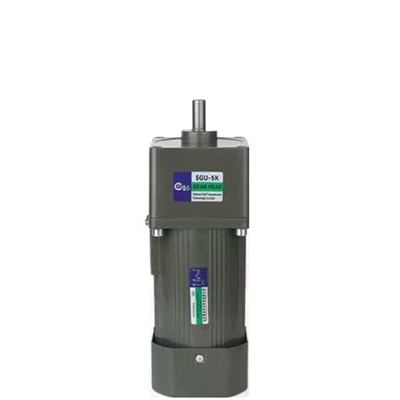
As a supplier of 400W AC Gear Motors, I've had countless discussions with clients trying to understand the differences between a 400W AC Gear Motor and a servo motor. This blog post aims to provide a comprehensive comparison of these two types of motors, helping you make an informed decision for your specific application.
Operating Principle
400W AC Gear Motor
A 400W AC Gear Motor operates on alternating current (AC). The basic principle involves the interaction between the magnetic field produced by the stator (the stationary part of the motor) and the current - carrying conductors in the rotor (the rotating part). The gear mechanism in the motor is used to adjust the speed and torque output. By reducing the speed, the gearbox increases the torque, which is useful in applications where high torque is required at low speeds. For example, in conveyor systems, a 400W AC Gear Motor with the appropriate gear ratio can provide the necessary force to move heavy loads steadily.
Servo Motor
Servo motors work on a closed - loop control system. They consist of a DC or AC motor, a feedback device (such as an encoder), and a control circuit. The encoder continuously monitors the position, speed, and sometimes the torque of the motor shaft. The control circuit compares the actual position of the shaft with the desired position and makes adjustments to the motor's power input accordingly. This precise control makes servo motors ideal for applications that require high accuracy, like robotic arms and CNC machines.
Performance Characteristics
Speed
The speed of a 400W AC Gear Motor is relatively fixed for a given input voltage and gear ratio. Once the motor is running, its speed remains stable under normal operating conditions. However, the speed can be adjusted by changing the input voltage or the gear ratio. For example, using a variable - frequency drive (VFD) can change the speed of an AC motor by altering the frequency of the AC power supply.
On the other hand, servo motors offer extremely precise speed control. They can operate smoothly at a wide range of speeds, from very slow to very high. The speed can be changed instantaneously in response to the control signal, allowing for rapid acceleration and deceleration. This makes servo motors suitable for applications such as high - speed packaging machines, where speed adjustment is crucial during the production process.
Torque
A 400W AC Gear Motor can provide high starting torque, especially when a suitable gear reduction ratio is used. The gearbox multiplies the motor's torque, enabling the motor to handle heavy loads at startup. For instance, in some industrial mixers, a 400W AC Gear Motor can start the mixing process even when the mixer is filled with a thick and viscous substance.
Servo motors also have good torque control capabilities. They can provide high torque at low speeds and maintain a relatively constant torque throughout their speed range. In addition, servo motors can generate high peak torque for short periods, which is useful for applications that require sudden and powerful movements, such as in pick - and - place robots.
Accuracy
When it comes to accuracy, servo motors have a significant advantage over 400W AC Gear Motors. Due to their closed - loop control system, servo motors can achieve extremely high - resolution positioning. They can accurately reach and maintain a specific position within a very small tolerance, sometimes as low as a few arc - seconds.
In contrast, 400W AC Gear Motors are not as accurate in terms of positioning. While they can provide stable operation, achieving precise positioning usually requires additional mechanical or control mechanisms. For example, in a simple roller - shutter door system, a 400W AC Gear Motor can open and close the door, but it may not be able to position the door at a specific height with high accuracy without additional sensors and control.
Applications
400W AC Gear Motor
The 400W AC Gear Motor is widely used in various industrial and commercial applications. One of the most common applications is in conveyor systems. Conveyor belts need a motor that can provide a constant and reliable power source to move goods from one place to another. The high torque and relatively simple control of a 400W AC Gear Motor make it an ideal choice for this type of application.
Another application is in industrial fans and blowers. These devices need a motor that can operate continuously at a stable speed to generate the required air flow. The 400W AC Gear Motor can meet this requirement and is often used to drive fans in ventilation systems, cooling towers, and industrial heaters.


If you are interested in other types of gear motors, you can check out our 200W AC Gear Motor, Gear Reduction Motor, and Worm Gear Reduction Motor.
Servo Motor
Servo motors are mainly used in applications that demand high precision and dynamic performance. In the robotics industry, servo motors are the heart of robotic arms. They allow the robot to move with high accuracy, pick up and place objects precisely, and perform complex tasks such as welding and assembly.
CNC (Computer Numerical Control) machines also rely heavily on servo motors. These machines need to cut, drill, and shape materials with extreme precision. The servo motors' ability to control the position, speed, and torque of the machine's axes enables the CNC machine to produce high - quality parts with tight tolerances.
Cost and Maintenance
Cost
In general, 400W AC Gear Motors are more cost - effective than servo motors. The simpler design and fewer control components of AC Gear Motors result in a lower manufacturing cost. They are also relatively inexpensive to install, as they do not require complex control systems like servo motors. This makes them a popular choice for applications with budget constraints.
Servo motors, on the other hand, are more expensive. The cost of the feedback device, the control circuit, and the more advanced manufacturing process contribute to the higher price. However, in applications where high precision and performance are essential, the benefits of using a servo motor often outweigh the additional cost.
Maintenance
400W AC Gear Motors are relatively easy to maintain. They have fewer moving parts compared to servo motors, and the gearbox can be easily lubricated and serviced. The motor itself is also robust and can withstand harsh operating conditions. In most cases, regular inspections and minor adjustments are sufficient to keep the motor in good working condition.
Servo motors require more frequent maintenance. The feedback device, such as the encoder, needs to be calibrated regularly to ensure accurate performance. The control circuit also needs to be checked for any potential faults. Additionally, servo motors are more sensitive to environmental factors such as dust, humidity, and temperature, which may require additional protection and monitoring.
Conclusion
In summary, the 400W AC Gear Motor and the servo motor have distinct differences in terms of operating principle, performance characteristics, applications, cost, and maintenance. The 400W AC Gear Motor is a reliable and cost - effective option for applications that require stable speed, high torque, and relatively simple control, such as conveyor systems and industrial fans. Servo motors, however, are the go - to choice for applications that demand high precision, dynamic performance, and accurate positioning, such as robotics and CNC machines.
If you are still unsure which type of motor is best for your application or would like to learn more about our 400W AC Gear Motors, please don't hesitate to get in touch with us. We are here to help you make the right decision and provide you with a high - quality product that meets your needs.
References
- "Electric Motors and Drives: Fundamentals, Types and Applications" by Austin Hughes and Bill Drury
- "Modern Control Engineering" by Katsuhiko Ogata