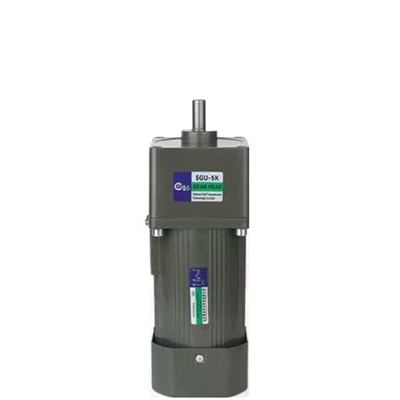
In the realm of industrial machinery and automation, gear motors play a pivotal role. As a seasoned gear motor supplier, I've encountered numerous inquiries regarding various aspects of gear motors. One question that frequently surfaces is: "What is the deceleration time of a gear motor?" In this blog post, I'll delve into this topic, exploring the concept of deceleration time, the factors influencing it, and its significance in practical applications.
Understanding Deceleration Time
The deceleration time of a gear motor refers to the duration it takes for the motor to slow down from its operating speed to a complete stop. It is a critical parameter that impacts the performance and safety of equipment powered by gear motors. A well - defined deceleration time ensures smooth operation, reduces mechanical stress on components, and prevents damage caused by sudden stops.
Imagine a conveyor belt system in a manufacturing plant. If the gear motor driving the conveyor belt stops too abruptly, the items on the belt may be jolted, leading to product damage. On the other hand, if the deceleration time is too long, it can slow down the overall production process. Therefore, finding the optimal deceleration time is essential for efficient and reliable operation.
Factors Affecting Deceleration Time
Several factors influence the deceleration time of a gear motor. Understanding these factors can help in selecting the right gear motor for a specific application and adjusting the deceleration time as needed.
Load Inertia
Load inertia is one of the most significant factors affecting deceleration time. Inertia is the property of an object to resist changes in its state of motion. A high - inertia load, such as a large flywheel or a heavy conveyor belt, requires more time and energy to slow down compared to a low - inertia load. For instance, a Worm Gear Reduction Motor driving a heavy - duty winch will have a longer deceleration time due to the high inertia of the winch drum and the load it is carrying.
Motor Torque
The torque output of the gear motor also plays a crucial role in determining the deceleration time. Torque is the rotational force that the motor can generate. A motor with higher torque can slow down the load more quickly. If a 400W AC Gear Motor and a 200W AC Gear Motor are used to drive the same load, the 400W motor, which generally has higher torque, will likely have a shorter deceleration time.
Braking System
The type and effectiveness of the braking system installed on the gear motor can significantly impact the deceleration time. Some gear motors are equipped with electromagnetic brakes, which can provide rapid and controlled braking. These brakes can be adjusted to vary the deceleration time according to the requirements of the application. Other braking methods, such as dynamic braking or regenerative braking, also affect the deceleration characteristics of the motor.
Control Settings
The control settings of the motor drive or controller can be adjusted to change the deceleration time. Modern motor drives allow users to set the deceleration rate precisely. By increasing the deceleration rate, the motor will slow down more quickly, while a lower deceleration rate will result in a longer deceleration time.
Significance of Deceleration Time in Different Applications
The deceleration time of a gear motor has different implications in various applications.
Conveyor Systems
In conveyor systems, proper deceleration time is crucial for the smooth transfer of goods. A well - adjusted deceleration time ensures that the items on the conveyor belt come to a stop gently without causing damage. It also helps in synchronizing the movement of multiple conveyors in a complex system.
Robotics
In robotic applications, the deceleration time affects the accuracy and repeatability of the robot's movements. Precise control of deceleration is necessary for the robot to reach its target position accurately and perform tasks with high precision.
Packaging Machines
In packaging machines, the deceleration time of the gear motor determines the speed at which the packaging process can be carried out. Adequate deceleration time allows for proper sealing and labeling of packages without causing any misalignment or damage.
Calculating Deceleration Time
Calculating the deceleration time of a gear motor involves considering the factors mentioned above. The following is a simplified formula for estimating the deceleration time:
[t_d=\frac{2\pi J\Delta N}{60T_b}]


Where:
- (t_d) is the deceleration time in seconds
- (J) is the total inertia of the load and the motor in (kg\cdot m^2)
- (\Delta N) is the change in speed in revolutions per minute (RPM)
- (T_b) is the braking torque in (N\cdot m)
However, in real - world applications, the calculation can be more complex due to factors such as friction, variable loads, and the characteristics of the braking system. It is often recommended to consult the motor manufacturer or an expert in the field for accurate calculations.
Selecting the Right Gear Motor Based on Deceleration Requirements
When selecting a gear motor for a specific application, it is essential to consider the deceleration requirements. Here are some guidelines:
- Assess the Load Inertia: Determine the inertia of the load that the motor will drive. Choose a motor with sufficient torque to handle the load and achieve the desired deceleration time.
- Consider the Braking System: If rapid deceleration is required, look for a gear motor with a reliable and adjustable braking system.
- Evaluate the Control Options: Select a motor drive or controller that allows for easy adjustment of the deceleration time. This will provide flexibility in fine - tuning the motor's performance.
Conclusion
The deceleration time of a gear motor is a critical parameter that affects the performance, safety, and efficiency of industrial equipment. As a gear motor supplier, I understand the importance of providing customers with the right information and products to meet their deceleration requirements. Whether you need a Worm Gear Reduction Motor, a 400W AC Gear Motor, or a 200W AC Gear Motor, we have a wide range of options to suit your needs.
If you are looking for a gear motor for your application and need assistance in determining the appropriate deceleration time or selecting the right product, please feel free to contact us. Our team of experts is ready to provide you with professional advice and support. We can help you optimize your equipment's performance and ensure smooth operation.
References
- "Electric Motors and Drives: Fundamentals, Types and Applications" by Austin Hughes
- "Motion Control Handbook" by David A. Bender