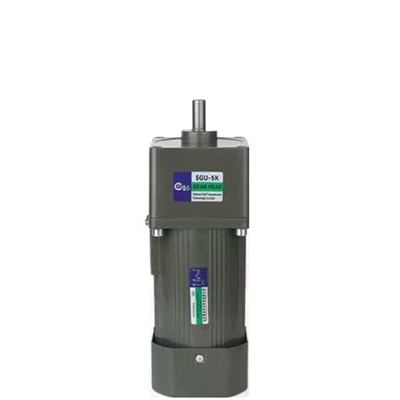
What is the current rating of a single phase motor?
As a dedicated supplier of single phase motors, I often encounter inquiries about the current rating of these motors. Understanding the current rating is crucial for both the proper selection and safe operation of single phase motors. In this blog, I will delve into the concept of current rating, its significance, and how it relates to our range of single phase motors, including the 220 Volt Single Phase Motor, ML Series Single Phase Motor, and YL Series Single Phase Motor.
What is Current Rating?
The current rating of a single phase motor refers to the maximum amount of electrical current that the motor can safely carry under normal operating conditions. It is typically specified in amperes (A) and is an important parameter that determines the motor's capacity and performance. The current rating is determined by several factors, including the motor's power rating, voltage, efficiency, and power factor.
Significance of Current Rating
The current rating of a single phase motor is significant for several reasons. Firstly, it ensures the safe operation of the motor. If the motor is subjected to a current higher than its rated value, it can overheat, which can lead to insulation damage, reduced motor life, and even fire hazards. Therefore, it is essential to select a motor with a current rating that is appropriate for the application.
Secondly, the current rating affects the motor's performance. A motor operating at or near its rated current will generally provide optimal performance in terms of torque, speed, and efficiency. On the other hand, if the motor is operating at a current significantly lower than its rated value, it may not be able to deliver the required power, resulting in reduced performance and increased energy consumption.
Factors Affecting Current Rating
As mentioned earlier, several factors influence the current rating of a single phase motor. Let's take a closer look at each of these factors:
- Power Rating: The power rating of a motor is the amount of mechanical power it can deliver. It is typically specified in watts (W) or horsepower (hp). Generally, the higher the power rating of a motor, the higher its current rating. This is because a more powerful motor requires more electrical energy to operate.
- Voltage: The voltage at which the motor operates also affects its current rating. According to Ohm's law (I = V/R), where I is the current, V is the voltage, and R is the resistance, the current is directly proportional to the voltage. Therefore, a motor designed to operate at a higher voltage will generally have a lower current rating compared to a motor designed for a lower voltage, assuming the power rating remains the same.
- Efficiency: The efficiency of a motor is the ratio of the mechanical power output to the electrical power input. A more efficient motor will convert a higher percentage of the electrical energy into mechanical energy, resulting in a lower current draw for the same power output. Therefore, motors with higher efficiency ratings generally have lower current ratings.
- Power Factor: The power factor of a motor is a measure of how effectively it uses the electrical power supplied to it. It is the ratio of the real power (in watts) to the apparent power (in volt-amperes). A motor with a low power factor will draw more current for the same amount of real power compared to a motor with a high power factor. Therefore, motors with higher power factor ratings generally have lower current ratings.
Calculating Current Rating
The current rating of a single phase motor can be calculated using the following formula:
[I = \frac{P}{V \times PF \times \eta}]


Where:
- (I) is the current in amperes (A)
- (P) is the power rating of the motor in watts (W)
- (V) is the voltage at which the motor operates in volts (V)
- (PF) is the power factor of the motor
- (\eta) is the efficiency of the motor
For example, let's calculate the current rating of a 220 Volt Single Phase Motor with a power rating of 1000 W, a power factor of 0.8, and an efficiency of 0.9.
[I = \frac{1000}{220 \times 0.8 \times 0.9} \approx 6.3 A]
This means that the motor should be able to safely carry a current of up to approximately 6.3 A under normal operating conditions.
Our Single Phase Motor Range
At our company, we offer a wide range of single phase motors, including the ML Series Single Phase Motor and YL Series Single Phase Motor. These motors are designed to meet the diverse needs of our customers, with different power ratings, voltage options, and current ratings.
Our ML Series Single Phase Motor is known for its high efficiency, reliable performance, and compact design. It is available in various power ratings, from a few hundred watts to several kilowatts, and is suitable for a wide range of applications, including fans, pumps, compressors, and small machinery.
The YL Series Single Phase Motor is another popular choice among our customers. It features a robust construction, high starting torque, and excellent speed regulation. This series of motors is also available in different power ratings and is commonly used in applications such as conveyors, mixers, and agricultural equipment.
Conclusion
In conclusion, the current rating of a single phase motor is a crucial parameter that determines its safe operation and performance. It is influenced by factors such as power rating, voltage, efficiency, and power factor. By understanding these factors and calculating the current rating accurately, you can select the right motor for your application.
As a single phase motor supplier, we are committed to providing our customers with high-quality motors that meet their specific requirements. Our 220 Volt Single Phase Motor, ML Series Single Phase Motor, and YL Series Single Phase Motor are designed to offer reliable performance, energy efficiency, and long service life.
If you are in the market for a single phase motor or have any questions about current ratings or our product range, please do not hesitate to contact us. We are here to assist you in making the right choice for your application.
References
- Electric Machinery Fundamentals, Stephen J. Chapman
- Electrical Engineering Handbook, Richard C. Dorf