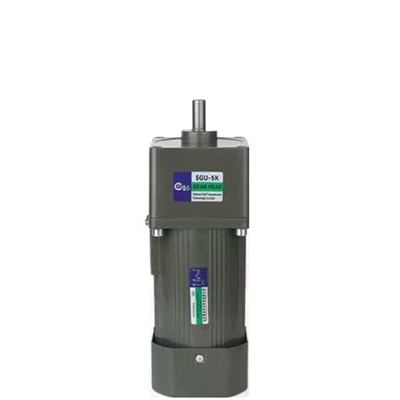
A 400W AC gear motor is a remarkable piece of machinery that combines the power of an alternating current (AC) motor with the mechanical advantage of a gear system. As a supplier of these motors, I am often asked about how they work. In this blog post, I will provide a detailed explanation of the working principles of a 400W AC gear motor, its components, and its applications.
Understanding the Basics of an AC Motor
Before delving into the specifics of a 400W AC gear motor, it's essential to understand the basic operation of an AC motor. An AC motor converts electrical energy into mechanical energy through the interaction of magnetic fields. It consists of two main parts: the stator and the rotor.
The stator is the stationary part of the motor. It contains a series of coils that are connected to an AC power source. When an alternating current flows through these coils, it creates a rotating magnetic field. This magnetic field rotates at a speed determined by the frequency of the AC power supply and the number of poles in the motor.


The rotor is the rotating part of the motor. It is typically made of a laminated core with conductors (either squirrel-cage or wound) placed in slots around its periphery. The rotating magnetic field of the stator induces an electric current in the conductors of the rotor. According to Ampere's law, this current-carrying conductor experiences a force in the presence of a magnetic field, which causes the rotor to rotate.
The Role of the Gear System
The gear system in a 400W AC gear motor is what sets it apart from a standard AC motor. Gears are toothed wheels that mesh together to transmit power and change the speed and torque of the motor. In a gear motor, the gear system is connected to the output shaft of the AC motor.
There are several types of gear systems used in 400W AC gear motors, including spur gears, helical gears, and worm gears. Each type has its own advantages and is suitable for different applications.
- Spur Gears: These are the simplest and most common type of gears. They have straight teeth that are parallel to the axis of rotation. Spur gears are efficient and can transmit high amounts of power. However, they can be noisy, especially at high speeds.
- Helical Gears: Helical gears have teeth that are cut at an angle to the axis of rotation. This design allows for smoother and quieter operation compared to spur gears. Helical gears can also transmit more power and are suitable for high-speed applications.
- Worm Gears: A worm gear consists of a worm (a screw-like shaft) and a worm wheel (a toothed gear). Worm gears provide a high reduction ratio, which means they can significantly reduce the speed of the motor while increasing the torque. They are also self-locking, which means they can hold a load in place without the need for a brake. You can learn more about Worm Gear Reduction Motor on our website.
How the 400W AC Gear Motor Works
Now that we understand the basics of an AC motor and the role of the gear system, let's look at how a 400W AC gear motor works as a whole.
When the 400W AC gear motor is connected to an AC power source, the stator creates a rotating magnetic field. This magnetic field induces an electric current in the rotor, causing it to rotate. The rotation of the rotor is then transmitted to the gear system.
The gear system takes the high-speed, low-torque output of the motor and converts it into a low-speed, high-torque output. This is achieved through the principle of gear reduction. The gear ratio, which is the ratio of the number of teeth on the driven gear to the number of teeth on the driving gear, determines the amount of speed reduction and torque increase.
For example, if a gear motor has a gear ratio of 10:1, the output speed of the gear system will be one-tenth of the input speed of the motor, while the output torque will be ten times the input torque. This makes the 400W AC gear motor suitable for applications that require high torque at low speeds, such as conveyor systems, industrial machinery, and automotive applications.
Applications of 400W AC Gear Motors
400W AC gear motors are used in a wide range of applications due to their high torque output and precise speed control. Some common applications include:
- Conveyor Systems: In conveyor systems, 400W AC gear motors are used to drive the conveyor belts. The high torque output of the motor allows it to move heavy loads along the conveyor at a constant speed.
- Industrial Machinery: Many industrial machines, such as mixers, crushers, and pumps, require high torque at low speeds. 400W AC gear motors are ideal for these applications as they can provide the necessary power and control.
- Automotive Applications: In the automotive industry, 400W AC gear motors are used in various applications, such as power windows, windshield wipers, and seat adjusters. The compact size and high torque output of these motors make them suitable for use in tight spaces.
- Home Appliances: Some home appliances, such as washing machines and refrigerators, also use 400W AC gear motors. These motors provide the necessary power to drive the moving parts of the appliances.
Advantages of Our 400W AC Gear Motors
As a supplier of 400W AC gear motors, we take pride in offering high-quality products that meet the needs of our customers. Here are some of the advantages of our 400W AC gear motors:
- High Efficiency: Our motors are designed to be highly efficient, which means they consume less energy and generate less heat. This not only saves on operating costs but also extends the lifespan of the motor.
- Reliability: We use high-quality materials and advanced manufacturing processes to ensure the reliability of our motors. Our motors are tested rigorously to meet strict quality standards and can withstand harsh operating conditions.
- Customization: We understand that different applications have different requirements. That's why we offer customization options for our 400W AC gear motors. We can customize the motor's speed, torque, gear ratio, and other parameters to meet your specific needs.
- Technical Support: Our team of experienced engineers is available to provide technical support and assistance. Whether you have questions about the installation, operation, or maintenance of our motors, we are here to help.
Why Choose Us as Your Supplier
When it comes to choosing a supplier for your 400W AC gear motor needs, there are several reasons why you should choose us:
- Wide Range of Products: In addition to 400W AC gear motors, we also offer a wide range of other gear motors, such as 200W AC Gear Motor and Gear Reduction Motor. This allows you to find the right motor for your application from a single source.
- Competitive Pricing: We offer competitive pricing for our products without compromising on quality. Our goal is to provide you with the best value for your money.
- Fast Delivery: We understand the importance of timely delivery. That's why we have a well-established supply chain and logistics system in place to ensure fast delivery of our products.
Contact Us for Your Gear Motor Needs
If you are interested in our 400W AC gear motors or have any questions about our products, please don't hesitate to contact us. Our team is ready to assist you with your gear motor requirements and provide you with a customized solution. Whether you are looking for a standard motor or a customized design, we have the expertise and resources to meet your needs.
References
- Fitzgerald, A. E., Kingsley, C., & Umans, S. D. (2003). Electric Machinery (6th ed.). McGraw-Hill.
- Chapman, S. J. (2005). Electric Machinery Fundamentals (4th ed.). McGraw-Hill.
- Norton, R. L. (2006). Design of Machinery: An Introduction to the Synthesis and Analysis of Mechanisms and Machines (4th ed.). McGraw-Hill.