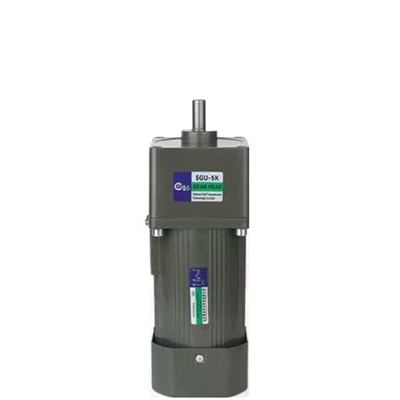
Hey there! As a single phase motor supplier, I often get asked about the braking methods for single phase motors. It's a crucial topic because proper braking can enhance the safety and efficiency of these motors in various applications. In this blog, I'll walk you through the different braking methods for single phase motors, how they work, and when to use them.
First off, let's understand why we need to brake a single phase motor. When you turn off a single phase motor, it doesn't just stop instantly. Due to inertia, it keeps rotating for a while. In some applications like conveyor belts, elevators, or machinery where precise positioning is required, this continued rotation can be a big problem. That's where braking methods come in handy.
1. Mechanical Braking
One of the most common ways to stop a single phase motor is through mechanical braking. This method works by using a physical mechanism to slow down and eventually stop the motor's rotation.


Friction Brakes
Friction brakes are the most straightforward type of mechanical brakes. They work by applying a frictional force to the motor's rotating shaft or a connected component. There are two main types of friction brakes: shoe brakes and disc brakes.
- Shoe Brakes: In shoe brakes, a pair of shoes lined with a friction material are pressed against a rotating drum attached to the motor shaft. When the brake is activated, the shoes squeeze the drum, creating friction that slows down the rotation. Shoe brakes are relatively simple and cost - effective, making them suitable for a wide range of applications. However, they can wear out over time, and regular maintenance is required to ensure proper braking performance.
- Disc Brakes: Disc brakes use a flat disc attached to the motor shaft. Brake pads are then pressed against both sides of the disc to create friction. Disc brakes offer better heat dissipation compared to shoe brakes, which means they can handle more frequent braking without overheating. They also provide more precise control of the braking force, making them ideal for applications where accurate stopping is essential.
The advantage of mechanical braking is that it's a very reliable method. It can work even in case of a power failure, which is a big plus for safety - critical applications. But the downside is that it requires regular maintenance, and there's always some wear and tear involved.
2. Electrical Braking
Electrical braking methods use the motor's electrical properties to slow it down. There are a few different types of electrical braking that are commonly used for single phase motors.
Plugging
Plugging, also known as reverse current braking, is a simple yet effective electrical braking method. In this method, the phase sequence of the motor's supply voltage is reversed. When this happens, the motor produces a torque in the opposite direction of its rotation, which quickly slows it down.
The main advantage of plugging is that it can stop the motor very quickly. However, there are some drawbacks. When you reverse the phase sequence, a large current flows through the motor, which can cause overheating and damage if done too frequently. Also, when the motor stops, it tries to start rotating in the opposite direction, so you need an additional mechanism to prevent this.
Dynamic Braking
Dynamic braking works by converting the kinetic energy of the rotating motor into electrical energy. In a single phase motor, this is usually done by connecting a resistor across the motor terminals when the power supply is cut off. The motor then acts as a generator, and the electrical energy produced is dissipated as heat in the resistor.
Dynamic braking is a gentler way of stopping the motor compared to plugging. It doesn't cause the same level of current surges, so there's less risk of overheating. However, it's not as fast as plugging, and the braking force decreases as the motor slows down.
Regenerative Braking
Regenerative braking is a more advanced form of electrical braking. It's similar to dynamic braking in that the motor acts as a generator, but instead of dissipating the electrical energy as heat, it's fed back into the power supply. This makes regenerative braking a very energy - efficient method.
However, regenerative braking requires more complex control circuitry and is more expensive to implement. It's typically used in applications where energy savings are a priority, such as in some types of electric vehicles or industrial machinery with high - power motors.
Choosing the Right Braking Method
So, how do you choose the right braking method for your single phase motor? Well, it depends on several factors.
- Application Requirements: If you need the motor to stop very quickly, like in a high - speed conveyor belt, plugging might be a good option. But if you're more concerned about energy efficiency and gentle stopping, regenerative or dynamic braking could be better. For applications where safety is crucial and you need a reliable backup in case of power failure, mechanical braking is the way to go.
- Cost and Maintenance: Mechanical brakes are generally less expensive to install but require more maintenance. Electrical braking methods, on the other hand, may have a higher initial cost but can be more cost - effective in the long run, especially if they save energy.
At our company, we offer a wide range of single phase motors, including the 220 Volt Single Phase Motor, YL Series Single Phase Motor, and ML Series Single Phase Motor. We can help you choose the right motor and the appropriate braking method for your specific application.
If you're in the market for single phase motors or have any questions about braking methods, don't hesitate to reach out. We're here to assist you in finding the best solutions for your needs. Let's start a conversation and see how we can work together to meet your motor requirements.
References
- Chapman, Stephen J. "Electric Machinery Fundamentals." McGraw - Hill Education, 2012.
- Fitzgerald, A. E., Kingsley Jr., C., & Umans, S. D. "Electric Machinery." McGraw - Hill Education, 2003.