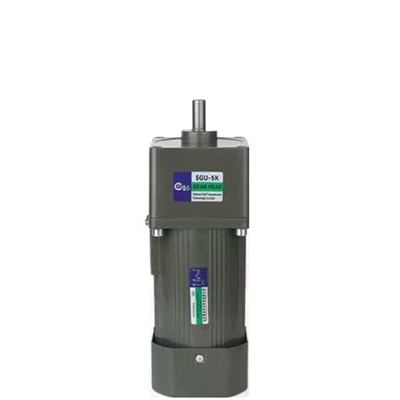
In the realm of industrial machinery and electrical engineering, IE4 electric motors stand out as a pinnacle of efficiency and performance. As a leading supplier of IE4 electric motors, I am often asked about various technical aspects of these motors, one of the most frequently inquired topics being the back - EMF of the IE4 electric motor. In this blog, I aim to demystify the concept of back - EMF in IE4 electric motors, exploring its significance, how it operates, and its impact on motor performance.
Understanding the Basics of EMF and Back - EMF
To comprehend back - EMF, we first need to understand the concept of electromotive force (EMF). EMF is essentially the electrical potential difference generated by a source such as a battery or a generator. It is the driving force that pushes electric charges through a circuit, creating an electric current.
In an electric motor, the principle is based on the interaction between magnetic fields and electric currents. When an electric current is passed through the coils of a motor, a magnetic field is generated. This magnetic field interacts with the permanent magnetic field (in the case of a permanent - magnet motor) or the magnetic field of another coil (in an induction motor), causing the motor to rotate.
However, according to Faraday's law of electromagnetic induction, when a conductor (such as the coils in a motor) moves in a magnetic field, an EMF is induced in the conductor. In the context of an electric motor, as the motor rotates, the coils move through the magnetic field, and an EMF is induced in these coils. This induced EMF is in the opposite direction to the applied voltage that is driving the motor. This is what we call back - EMF.
Back - EMF in IE4 Electric Motors
IE4 electric motors are designed to meet the highest efficiency standards in the market. These motors are known for their low energy consumption, high power density, and excellent performance. Back - EMF plays a crucial role in the operation and efficiency of IE4 electric motors.


How Back - EMF Affects Motor Operation
The back - EMF in an IE4 electric motor acts as a natural regulator of the motor's speed and current. When the motor is starting, the back - EMF is initially zero because the motor is not rotating. As a result, the current flowing through the motor coils is relatively high, as there is no opposing EMF. This high current provides the necessary torque to start the motor's rotation.
As the motor speeds up, the back - EMF increases proportionally to the motor's speed. The back - EMF opposes the applied voltage, reducing the net voltage across the motor coils. According to Ohm's law (I = V/R, where I is current, V is voltage, and R is resistance), a decrease in the net voltage results in a decrease in the current flowing through the motor. This self - regulating mechanism ensures that the motor does not draw excessive current once it has reached its operating speed.
Impact on Efficiency
One of the key advantages of IE4 electric motors is their high efficiency. Back - EMF contributes significantly to this efficiency. By reducing the current flowing through the motor at operating speed, back - EMF minimizes the power losses due to the resistance of the motor coils (known as copper losses, calculated as (P = I^{2}R), where (P) is power loss, (I) is current, and (R) is resistance). Lower copper losses mean that more of the electrical energy supplied to the motor is converted into mechanical energy, resulting in higher efficiency.
Moreover, the self - regulating nature of back - EMF helps to maintain a stable speed under varying load conditions. When a load is applied to the motor, the motor slows down slightly. This causes the back - EMF to decrease, which in turn increases the net voltage across the motor coils and the current. The increased current provides the additional torque needed to overcome the load and maintain the motor's speed.
Measuring and Controlling Back - EMF in IE4 Electric Motors
As a supplier of IE4 electric motors, we understand the importance of accurately measuring and controlling back - EMF. Measuring back - EMF can provide valuable information about the motor's operating conditions, such as speed and load.
Measuring Back - EMF
There are several methods for measuring back - EMF in an IE4 electric motor. One common approach is to use a voltage sensor to measure the voltage across the motor terminals. By subtracting the voltage drop across the motor's internal resistance (which can be calculated based on the measured current and the known resistance of the coils) from the terminal voltage, we can estimate the back - EMF.
Another method is to use a speed sensor, such as an encoder or a tachometer, to measure the motor's speed. Since back - EMF is proportional to the motor's speed, we can calculate the back - EMF based on the measured speed and the motor's design parameters.
Controlling Back - EMF
Controlling back - EMF is essential for optimizing the performance of IE4 electric motors. In some applications, such as variable - speed drives, the back - EMF can be controlled by adjusting the applied voltage or the frequency of the power supply. By carefully controlling the back - EMF, we can ensure that the motor operates at its maximum efficiency over a wide range of speeds and loads.
Applications and Considerations
IE4 electric motors are used in a wide range of applications, from industrial machinery to HVAC systems. Understanding back - EMF is crucial for selecting the right motor for a specific application and ensuring its proper operation.
Industrial Applications
In industrial settings, IE4 electric motors are often used to drive pumps, fans, compressors, and conveyor belts. The self - regulating nature of back - EMF makes these motors well - suited for applications where the load may vary. For example, in a pump application, as the flow rate changes, the load on the motor also changes. The back - EMF mechanism allows the motor to adjust its current and torque automatically, ensuring efficient operation under different flow conditions.
HVAC Systems
In HVAC systems, IE4 electric motors are used in air handlers, chillers, and condensers. These motors need to operate efficiently over a wide range of speeds to meet the varying heating and cooling demands. Back - EMF control can be used to optimize the motor's performance in these applications, reducing energy consumption and improving system reliability.
When considering the use of IE4 electric motors, it is important to take into account the specific requirements of the application, such as the required speed range, torque, and load characteristics. Additionally, proper installation and maintenance are essential to ensure that the back - EMF mechanism functions correctly and the motor operates at its peak efficiency.
Our Product Range
As a leading supplier of IE4 electric motors, we offer a wide range of products to meet the diverse needs of our customers. Our product portfolio includes Cast Iron Three Phase Motor, Three Phase Brake Motor, and Aluminium Electric Motor.
These motors are designed and manufactured to the highest quality standards, ensuring reliable performance and long service life. Whether you need a motor for a small - scale industrial application or a large - scale HVAC system, we have the right solution for you.
Conclusion
In conclusion, back - EMF is a fundamental concept in the operation of IE4 electric motors. It plays a vital role in regulating the motor's speed, current, and efficiency. Understanding back - EMF is essential for anyone involved in the design, selection, or operation of IE4 electric motors.
As a supplier of IE4 electric motors, we are committed to providing our customers with high - quality products and technical support. If you are interested in learning more about our IE4 electric motors or have any questions about back - EMF or motor applications, we encourage you to contact us for a detailed discussion. We look forward to working with you to find the best motor solutions for your specific needs.
References
- Fitzgerald, A. E., Kingsley, C., & Umans, S. D. (2003). Electric Machinery. McGraw - Hill.
- Chapman, S. J. (2012). Electric Machinery Fundamentals. McGraw - Hill.