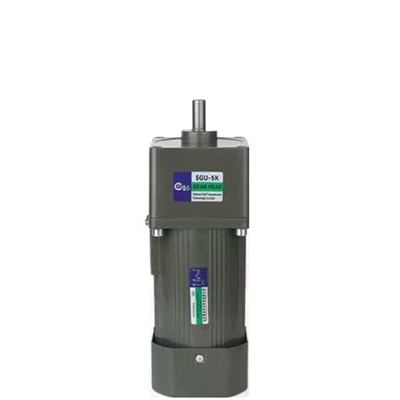
As a supplier of single phase motors, I've encountered various issues with these motors over the years. Single phase motors are widely used in many applications due to their simplicity and cost - effectiveness. However, like any mechanical and electrical device, they are prone to several common faults. Understanding these faults can help users troubleshoot problems quickly and ensure the smooth operation of their equipment.
1. Starting Problems
One of the most common issues with single phase motors is the inability to start. There are several reasons for this.
Faulty Starting Capacitor
The starting capacitor is crucial for providing the extra torque needed to start the motor. Over time, the capacitor can fail due to overheating, voltage surges, or normal wear and tear. When the starting capacitor fails, the motor may hum but not start. You can test the capacitor using a multimeter. If the capacitor shows a significantly lower capacitance value than its rated value, it needs to be replaced. For example, in our 220 Volt Single Phase Motor, a faulty starting capacitor can prevent the motor from getting the initial boost it requires to start rotating.
Open - Circuit in the Starting Winding
The starting winding is designed to create a rotating magnetic field during startup. If there is an open - circuit in the starting winding, the motor will not be able to generate the necessary torque to start. This can be caused by damaged wires, loose connections, or burnt - out windings. To check for an open - circuit, you can use a continuity tester. If there is no continuity in the starting winding, it may need to be repaired or replaced.
Mechanical Blockage
Sometimes, the problem is not electrical but mechanical. A mechanical blockage in the motor's shaft or the connected load can prevent the motor from starting. This could be due to debris, a seized bearing, or a misaligned coupling. Inspect the motor and the connected equipment for any signs of blockage. For instance, if a YL Series Single Phase Motor is used to drive a fan, and the fan blades are stuck, the motor will not be able to start.
2. Overheating
Overheating is another common fault in single phase motors. It can lead to premature failure of the motor if not addressed promptly.
Overloading
If the motor is operating under a load that exceeds its rated capacity, it will overheat. This can happen when the connected equipment requires more power than the motor can provide. For example, if a small single phase motor is used to drive a heavy - duty pump, the motor will have to work harder, generating more heat. Always ensure that the motor is properly sized for the load. Check the motor's nameplate for its rated power and compare it with the power requirements of the connected equipment.
Poor Ventilation
Proper ventilation is essential for dissipating the heat generated by the motor. If the motor is installed in a confined space or if the ventilation openings are blocked, the heat will build up inside the motor. Make sure that the motor has enough clearance around it and that the ventilation openings are clean and unobstructed. In the case of our ML Series Single Phase Motor, improper ventilation can cause the temperature to rise significantly, reducing the motor's lifespan.
Faulty Windings
Short - circuits or ground faults in the motor windings can also cause overheating. A short - circuit occurs when the insulation between the winding turns breaks down, allowing current to flow through an unintended path. This can lead to excessive current flow and heat generation. Ground faults happen when the winding comes into contact with the motor's frame. To detect these faults, you can use a megohmmeter to measure the insulation resistance of the windings.


3. Noise and Vibration
Excessive noise and vibration in a single phase motor can indicate several problems.
Unbalanced Rotor
An unbalanced rotor can cause the motor to vibrate and produce noise. This can be due to manufacturing defects, wear and tear, or damage to the rotor. Over time, the rotor may become unbalanced as parts wear unevenly. To check for an unbalanced rotor, you can use a vibration analyzer. If the rotor is unbalanced, it may need to be re - balanced or replaced.
Loose Mounting
If the motor is not properly mounted, it can vibrate and make noise. Loose bolts or a weak mounting surface can cause the motor to move during operation. Check the mounting bolts and ensure that they are tightened to the correct torque. Also, make sure that the mounting surface is flat and sturdy.
Worn - Out Bearings
Bearings support the motor's shaft and allow it to rotate smoothly. When the bearings wear out, they can cause noise and vibration. You can usually hear a grinding or whining noise if the bearings are worn. Inspect the bearings regularly for signs of wear, such as excessive play or rough surfaces. Replace the bearings if necessary.
4. Electrical Faults
Apart from the starting and overheating - related electrical issues, there are other electrical faults that can occur in single phase motors.
Voltage Fluctuations
Single phase motors are sensitive to voltage fluctuations. If the supply voltage is too high or too low, it can affect the motor's performance. A high voltage can cause the motor to draw excessive current, leading to overheating and potential damage to the windings. A low voltage can cause the motor to run at a reduced speed and may even prevent it from starting. Use a voltmeter to monitor the supply voltage and ensure that it is within the motor's rated voltage range.
Faulty Capacitor Run Circuit
In some single phase motors, a run capacitor is used to improve the motor's efficiency and power factor during normal operation. If the run capacitor fails, the motor may experience reduced performance, increased current draw, and overheating. Test the run capacitor regularly to ensure that it is functioning properly.
5. Low Efficiency
A single phase motor may also exhibit low efficiency, which means it consumes more power than necessary to perform its task.
Aging Components
As the motor ages, its components, such as the windings and capacitors, may degrade, leading to reduced efficiency. The insulation on the windings may break down over time, increasing the resistance and causing more power to be dissipated as heat. Regular maintenance and component replacement can help maintain the motor's efficiency.
Incorrect Wiring
Incorrect wiring can also lead to low efficiency. If the motor is wired incorrectly, it may not operate in the most efficient mode. For example, if the starting and running windings are connected in the wrong way, the motor may draw more current than required. Double - check the wiring diagram and ensure that all connections are made correctly.
In conclusion, being aware of these common faults in single phase motors can help you diagnose and fix problems quickly. As a supplier of single phase motors, we are committed to providing high - quality products and technical support. If you are experiencing any issues with your single phase motor or are looking to purchase a new one, we encourage you to contact us for a detailed discussion about your requirements. Our team of experts can help you select the right motor for your application and provide guidance on maintenance and troubleshooting.
References
- "Electric Motors and Control Techniques" by Tim Hughes
- "Electrical Motor Handbook" by Arnold E. Fitzgerald, Charles Kingsley Jr., and Stephen D. Umans