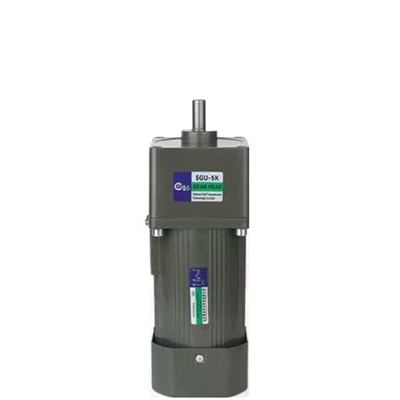
As a supplier of 400W AC Gear Motors, I understand the importance of ensuring the performance of these motors meets the highest standards. Testing the performance of a 400W AC Gear Motor is a crucial step in the manufacturing and quality control process. In this blog post, I will share some key methods and considerations for testing the performance of these motors.
Understanding the Basics of a 400W AC Gear Motor
Before diving into the testing process, it's essential to have a clear understanding of what a 400W AC Gear Motor is. These motors are designed to convert electrical energy into mechanical energy, with a power output of 400 watts. The gear mechanism in these motors allows for torque multiplication and speed reduction, making them suitable for a wide range of applications, such as conveyor systems, industrial machinery, and automation equipment.
Testing Equipment and Setup
To accurately test the performance of a 400W AC Gear Motor, you will need the following equipment:
- Power Supply: A stable AC power supply that can provide the rated voltage and frequency for the motor.
- Load Bank: A device that can simulate the load the motor will encounter in its actual application. This can be a mechanical brake, a dynamometer, or a combination of both.
- Measurement Instruments: Instruments such as voltmeters, ammeters, wattmeters, and tachometers are used to measure electrical parameters (voltage, current, power) and mechanical parameters (speed, torque) of the motor.
- Data Acquisition System: A system that can record and analyze the data collected during the testing process. This can be a dedicated data logger or a computer-based system with appropriate software.
The testing setup should be carefully configured to ensure accurate and reliable results. The motor should be securely mounted to a test bench, and all connections should be properly made to the power supply, load bank, and measurement instruments.
Performance Testing Procedures
1. No-Load Test
The no-load test is the first step in testing the performance of a 400W AC Gear Motor. In this test, the motor is run without any load attached. The purpose of this test is to measure the no-load current, power consumption, and speed of the motor.
- Connect the Motor: Connect the motor to the power supply and turn on the power. Make sure the motor starts smoothly and runs at a stable speed.
- Measure Parameters: Use the voltmeter, ammeter, and wattmeter to measure the voltage, current, and power consumption of the motor. Use the tachometer to measure the speed of the motor.
- Record Data: Record the measured values and calculate the no-load efficiency of the motor using the formula: Efficiency = (Output Power / Input Power) x 100%. In the no-load condition, the output power is zero, so the efficiency is also zero. However, the no-load power consumption can provide valuable information about the motor's internal losses.
2. Load Test
The load test is the most important test for evaluating the performance of a 400W AC Gear Motor. In this test, the motor is run with a load attached to it. The load can be gradually increased from zero to the rated load of the motor.
-
Apply Load: Use the load bank to apply a load to the motor. Start with a small load and gradually increase it in steps. At each step, allow the motor to reach a stable operating condition before taking measurements.
-
Measure Parameters: Measure the voltage, current, power consumption, speed, and torque of the motor at each load step. Use the data acquisition system to record the data.
-
Calculate Performance Parameters: Calculate the output power, input power, efficiency, and power factor of the motor at each load step using the following formulas:
- Output Power (Pout) = Torque (T) x Speed (ω)
- Input Power (Pin) = Voltage (V) x Current (I) x Power Factor (PF)
- Efficiency (η) = (Pout / Pin) x 100%
- Power Factor (PF) = Pout / (V x I)
-
Plot Performance Curves: Plot the performance curves of the motor, including the speed-torque curve, power-torque curve, and efficiency-torque curve. These curves can provide a visual representation of the motor's performance characteristics.


3. Overload Test
The overload test is used to evaluate the motor's ability to withstand short-term overloads. In this test, the motor is run at a load higher than its rated load for a specified period of time.
- Apply Overload: Use the load bank to apply an overload to the motor. The overload should be within the motor's short-term overload capacity, which is usually specified by the manufacturer.
- Monitor Parameters: Monitor the voltage, current, power consumption, speed, and temperature of the motor during the overload test. Make sure the motor does not overheat or trip the protection devices.
- Record Data: Record the measured values and observe the motor's behavior during the overload test. If the motor can withstand the overload without any problems, it indicates that the motor has good overload capacity.
4. Temperature Rise Test
The temperature rise test is used to evaluate the motor's thermal performance. In this test, the motor is run at its rated load for a specified period of time, and the temperature of the motor's windings and bearings is measured.
- Run the Motor at Rated Load: Connect the motor to the power supply and apply the rated load using the load bank. Let the motor run until it reaches a stable operating temperature.
- Measure Temperature: Use a thermometer or a temperature sensor to measure the temperature of the motor's windings and bearings at regular intervals. Record the measured values.
- Calculate Temperature Rise: Calculate the temperature rise of the motor by subtracting the ambient temperature from the measured temperature. The temperature rise should be within the limits specified by the manufacturer.
Considerations and Tips
- Safety First: When testing the performance of a 400W AC Gear Motor, safety should be the top priority. Make sure all safety precautions are taken, such as wearing appropriate personal protective equipment, using insulated tools, and following the electrical safety regulations.
- Test Environment: The test environment should be clean, dry, and well-ventilated. The temperature and humidity of the test environment should be within the acceptable range for the motor.
- Repeatability: To ensure the accuracy and reliability of the test results, the tests should be repeated several times under the same conditions. The average values of the measured parameters should be used for analysis and evaluation.
- Comparison with Specifications: Compare the test results with the motor's specifications provided by the manufacturer. If the test results deviate significantly from the specifications, it may indicate a problem with the motor or the testing process.
Conclusion
Testing the performance of a 400W AC Gear Motor is a complex but essential process. By following the procedures and considerations outlined in this blog post, you can ensure that the motors you supply meet the highest quality standards and perform reliably in their actual applications.
If you are interested in purchasing our 400W AC Gear Motors or have any questions about motor performance testing, please feel free to contact us for further discussion and negotiation. We also offer a wide range of other gear motors, such as Worm Gear Reduction Motor, 200W AC Gear Motor, and Gear Reduction Motor. Our team of experts is always ready to provide you with professional advice and support.
References
- Electric Machinery Fundamentals, Stephen J. Chapman
- Motor and Drive Troubleshooting, Dan Beaty