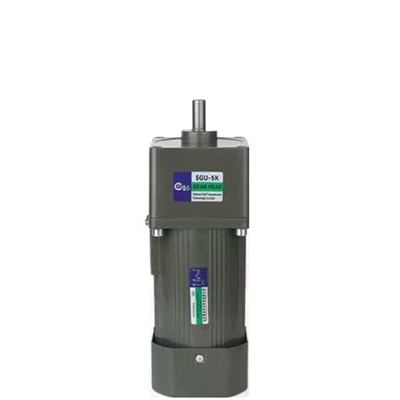
As a long - standing gear motor supplier, I've witnessed a wide range of scenarios related to gear motors, from their installation and operation to the inevitable moments when they require attention due to malfunctions. One question that frequently arises from our customers is, "Can a gear motor be repaired?" In this blog post, I'll delve into this topic, exploring the factors that determine repairability, the repair process, and the potential benefits and drawbacks of choosing repair over replacement.


Understanding Gear Motors
Before discussing the repairability of gear motors, it's essential to understand what they are and how they work. A gear motor is a combination of an electric motor and a gearbox. The electric motor provides the power, while the gearbox is used to control the speed and torque of the motor's output. Gear motors are widely used in various industries, such as manufacturing, automotive, and robotics, due to their ability to provide high torque at low speeds.
There are different types of gear motors, including 200W AC Gear Motor, Worm Gear Reduction Motor, and Gear Reduction Motor. Each type has its unique design and application, but they all share the same basic principle of using gears to modify the motor's output.
Factors Determining Repairability
Several factors come into play when determining whether a gear motor can be repaired. These factors include the age of the motor, the extent of the damage, the availability of replacement parts, and the cost - effectiveness of the repair.
Age of the Motor
Older gear motors may present more challenges when it comes to repair. As motors age, the materials used in their construction may degrade, and finding compatible replacement parts can become difficult. In some cases, the technology used in older motors may be obsolete, making it impossible to source the necessary components. However, if the motor has been well - maintained and the damage is minor, it may still be possible to repair it.
Extent of the Damage
The severity of the damage is a crucial factor. Minor issues such as loose connections, worn - out brushes in a DC motor, or a damaged gear tooth may be relatively easy to fix. For example, if a gear tooth is broken, it may be possible to replace just the damaged gear. On the other hand, if the motor has suffered major damage, such as a burnt - out stator or a severely damaged gearbox housing, the repair may be more complex and costly. In some cases, the damage may be so extensive that it is more practical to replace the entire motor.
Availability of Replacement Parts
The availability of replacement parts is another significant factor. If the manufacturer of the gear motor is still in business and the parts are readily available, the repair process will be much smoother. However, if the motor is from a discontinued line or a less - common brand, finding the necessary parts can be a challenge. In such cases, it may be necessary to fabricate custom parts, which can be time - consuming and expensive.
Cost - Effectiveness
The cost of repair is a major consideration. If the cost of repairing the gear motor is close to or exceeds the cost of a new motor, it may not be a cost - effective option. Additionally, the downtime associated with the repair should also be taken into account. In some industries, the loss of production during the repair period can be significant, making replacement a more attractive option.
The Repair Process
If a gear motor is deemed repairable, the repair process typically involves several steps.
Diagnosis
The first step is to diagnose the problem. This may involve visual inspection, electrical testing, and mechanical testing. A technician will check for signs of physical damage, such as cracks in the housing, worn - out gears, or loose connections. Electrical tests will be conducted to check the motor's windings for continuity and insulation resistance. Mechanical tests may include checking the motor's rotation, torque, and speed.
Disassembly
Once the problem has been identified, the gear motor will be disassembled. This involves removing the motor's housing, gears, bearings, and other components. Care must be taken during disassembly to avoid damaging any of the parts.
Repair or Replacement of Parts
Depending on the diagnosis, the damaged parts will either be repaired or replaced. For example, if a bearing is worn out, it will be replaced with a new one. If a gear has a minor defect, it may be possible to repair it by machining or welding.
Reassembly
After the damaged parts have been repaired or replaced, the gear motor will be reassembled. During reassembly, all the components must be properly aligned and tightened to ensure smooth operation.
Testing
Once the motor is reassembled, it will be tested to ensure that it is working properly. This may involve running the motor under load and checking its speed, torque, and other performance parameters.
Benefits of Repairing a Gear Motor
There are several benefits to repairing a gear motor instead of replacing it.
Cost Savings
In many cases, repairing a gear motor can be more cost - effective than buying a new one. This is especially true for minor repairs or when the motor is relatively new. By repairing the motor, you can avoid the high cost of purchasing a new unit.
Environmental Impact
Repairing a gear motor is also more environmentally friendly than replacing it. Manufacturing new motors requires a significant amount of energy and resources. By extending the lifespan of an existing motor through repair, you can reduce the demand for new products and minimize waste.
Familiarity and Compatibility
If the gear motor is already installed in a system, repairing it can ensure that the motor remains compatible with the existing equipment. This can save time and effort that would otherwise be spent on re - configuring the system to accommodate a new motor.
Drawbacks of Repairing a Gear Motor
However, there are also some drawbacks to consider when choosing to repair a gear motor.
Uncertainty of Repair
There is always a certain level of uncertainty when it comes to repairs. Even after a repair, there is no guarantee that the motor will not experience further problems in the future. In some cases, the root cause of the problem may not be fully identified, leading to recurring issues.
Downtime
The repair process can take time, especially if replacement parts need to be ordered. This downtime can be a significant problem in industries where continuous operation is crucial. In such cases, the loss of production during the repair period may outweigh the cost savings of the repair.
Conclusion
In conclusion, a gear motor can often be repaired, but it depends on several factors such as the age of the motor, the extent of the damage, the availability of replacement parts, and the cost - effectiveness of the repair. Repairing a gear motor can offer cost savings and environmental benefits, but it also comes with some uncertainties and potential downtime.
As a gear motor supplier, we are committed to providing our customers with the best advice on whether to repair or replace their gear motors. Our team of experts can help diagnose the problem, source the necessary parts, and carry out the repair if needed. If you are facing issues with your gear motor or are considering a purchase, we encourage you to get in touch with us. We can provide you with detailed information and assist you in making the most suitable decision for your specific needs.
References
- Groover, M. P. (2016). Automation, Production Systems, and Computer - Integrated Manufacturing. Pearson.
- Fitzgerald, A. E., Kingsley, C., & Umans, S. D. (2012). Electric Machinery. McGraw - Hill.