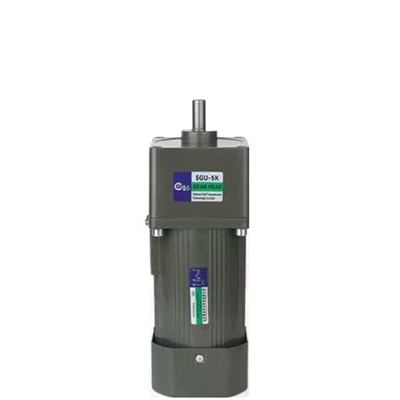
Hey there! As a supplier of single phase motors, I've been getting a lot of questions lately about the centrifugal switch and its role in these motors. So, I thought I'd take the time to break it down for you all.
Let's start with the basics. A single phase motor is a type of electric motor that runs on a single phase of AC power. These motors are commonly used in household appliances, small industrial equipment, and other applications where a relatively small amount of power is needed.
Now, the centrifugal switch is a crucial component in many single phase motors, especially those with a starting capacitor. The main job of the centrifugal switch is to disconnect the starting winding and the starting capacitor from the circuit once the motor reaches a certain speed.
When you first turn on a single phase motor, it needs a little extra help to get going. That's where the starting winding and the starting capacitor come in. The starting winding creates an additional magnetic field that helps the motor start rotating. The starting capacitor, on the other hand, provides a phase shift in the current flowing through the starting winding, which further enhances the starting torque of the motor.
But here's the thing: the starting winding and the starting capacitor are only needed during the starting phase of the motor. Once the motor reaches about 70 - 80% of its rated speed, they're no longer necessary. In fact, if they were to remain connected to the circuit, they could cause the motor to overheat and eventually burn out.
This is where the centrifugal switch steps in. It's usually mounted on the motor's shaft, and it consists of a set of weights and contacts. When the motor is at rest, the weights are in a position that closes the contacts, connecting the starting winding and the starting capacitor to the circuit. As the motor starts to rotate, the centrifugal force acting on the weights causes them to move outward. Once the motor reaches the predetermined speed, the weights move far enough to open the contacts, disconnecting the starting winding and the starting capacitor from the circuit.
Let me give you an example to illustrate this. Imagine you have a small single phase motor in a household fan. When you turn on the fan, the centrifugal switch is closed, and the starting winding and the starting capacitor help the motor get up to speed. As the fan blades start to spin faster and faster, the centrifugal force on the switch's weights increases. Once the motor reaches the right speed, the switch opens, and the motor continues to run on its main winding alone.
Now, you might be wondering why this is so important. Well, there are a few reasons. First of all, disconnecting the starting winding and the starting capacitor once the motor is up to speed helps to improve the motor's efficiency. The starting winding and the starting capacitor consume additional power, and by removing them from the circuit, the motor can operate more efficiently, using less energy.
Secondly, it helps to protect the motor from damage. As I mentioned earlier, leaving the starting winding and the starting capacitor connected for too long can cause the motor to overheat. By using a centrifugal switch to disconnect them at the right time, we can ensure that the motor operates within its safe temperature range, extending its lifespan.
At our company, we offer a wide range of single phase motors, including the YL Series Single Phase Motor, the ML Series Single Phase Motor, and the 220 Volt Single Phase Motor. All of these motors are designed with high - quality centrifugal switches to ensure reliable starting and efficient operation.
In some cases, though, the centrifugal switch can cause problems. For example, if the switch fails to open at the right time, the starting winding and the starting capacitor will remain connected to the circuit, leading to overheating. On the other hand, if the switch fails to close when the motor is at rest, the motor won't be able to start properly.
To prevent these issues, it's important to choose a high - quality centrifugal switch and to perform regular maintenance on your single phase motors. This includes checking the switch for signs of wear and tear, such as loose contacts or damaged weights, and replacing it if necessary.
Another thing to keep in mind is that not all single phase motors use a centrifugal switch. Some motors, such as permanent split capacitor (PSC) motors, don't have a starting winding or a starting capacitor, so they don't need a centrifugal switch. These motors are simpler in design and are often used in applications where a lower starting torque is acceptable.
So, in conclusion, the centrifugal switch plays a vital role in many single phase motors. It helps the motor start smoothly by providing the necessary starting torque and then ensures that the motor operates efficiently and safely by disconnecting the starting components once the motor is up to speed.
If you're in the market for a single phase motor, whether it's for a small household appliance or an industrial application, we've got you covered. Our motors are built to last and are designed with the latest technology to provide reliable performance. Don't hesitate to reach out if you have any questions or if you're interested in discussing your specific requirements. We're always happy to help you find the right motor for your needs.


References
- Electric Motors and Control Systems by Stephen L. Herman
- Electrical Machines by P. S. Bimbhra