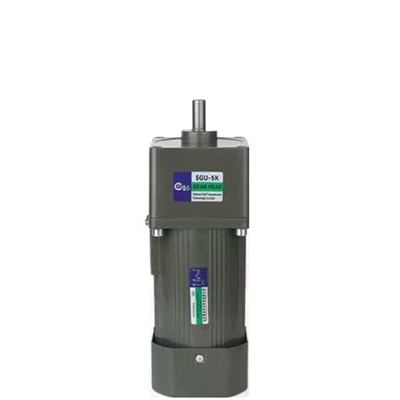
When it comes to industrial and automation applications, choosing the right motor is crucial. Two popular options that often come into consideration are the 400W AC Gear Motor and the stepper motor. As a supplier of 400W AC Gear Motors, I've had the opportunity to work with both types of motors and understand their unique characteristics. In this blog post, I'll delve into the differences between these two motors to help you make an informed decision for your specific needs.
Working Principle
Let's start with the fundamental working principles of these motors. A 400W AC Gear Motor is an alternating current motor combined with a gearbox. The AC power source provides the electrical energy, which creates a rotating magnetic field in the motor's stator. This magnetic field interacts with the rotor, causing it to rotate. The gearbox then reduces the speed of the motor and increases the torque output. This combination allows the motor to deliver high torque at low speeds, making it suitable for applications that require heavy lifting or high starting torque.
On the other hand, a stepper motor operates on a different principle. It divides a full rotation into a number of equal steps. Each step is achieved by energizing a specific set of coils in the motor. By controlling the sequence and timing of the coil energization, the motor can be precisely positioned and rotated in discrete steps. Stepper motors are known for their ability to provide accurate positioning and control without the need for feedback sensors in many applications.
Speed and Torque Characteristics
One of the significant differences between a 400W AC Gear Motor and a stepper motor lies in their speed and torque characteristics. The 400W AC Gear Motor typically offers a relatively constant torque over a wide range of speeds. The gearbox allows the motor to trade speed for torque, so it can generate high torque at low speeds. This makes it ideal for applications such as conveyor systems, mixers, and hoists, where a consistent amount of force is required to move heavy loads.
In contrast, stepper motors have a different torque - speed curve. At low speeds, stepper motors can provide high holding torque, which is useful for applications that require the motor to hold a position without moving. However, as the speed increases, the torque output of a stepper motor decreases significantly. This means that stepper motors are better suited for applications that require precise positioning at relatively low speeds, such as 3D printers, CNC machines, and robotic arms.
Control and Precision
Control and precision are also areas where these two motors differ. A 400W AC Gear Motor is usually controlled by adjusting the voltage or frequency of the AC power supply. Variable frequency drives (VFDs) are commonly used to control the speed of AC gear motors. While this allows for some degree of speed control, the precision of positioning is limited. AC gear motors are more suitable for applications where continuous motion and general speed control are required, rather than highly precise positioning.
Stepper motors, on the other hand, excel in precision control. As mentioned earlier, they can be controlled to move in discrete steps, which allows for extremely accurate positioning. The step size of a stepper motor can be as small as a fraction of a degree, depending on the motor's design. This makes stepper motors the go - to choice for applications that demand high precision, such as in the semiconductor manufacturing industry and medical equipment.
Efficiency and Power Consumption
Efficiency and power consumption are important factors to consider in any motor selection. A 400W AC Gear Motor generally has a relatively high efficiency, especially when operating at its rated load. The gearbox can introduce some losses, but modern gearbox designs have minimized these losses to a great extent. AC gear motors are often used in applications where they run continuously for long periods, and their efficiency helps to reduce energy costs over time.
Stepper motors, however, can be less efficient, especially at high speeds. Since they operate by energizing coils in a specific sequence, there is always some power consumption even when the motor is not moving. Additionally, the need to drive the coils with high - frequency pulses can lead to increased power losses. However, in applications where precise positioning is the primary requirement and the motor operates at low speeds, the trade - off in efficiency may be acceptable.
Cost and Maintenance
Cost is another factor that sets these two motors apart. A 400W AC Gear Motor is generally more cost - effective in terms of the initial purchase price. The technology behind AC gear motors is well - established, and they are mass - produced, which helps to keep the costs down. Moreover, the maintenance of AC gear motors is relatively straightforward. The main maintenance tasks usually involve checking the gearbox for lubrication and wear, and replacing the motor bearings if necessary.
Stepper motors, on the other hand, can be more expensive, especially those with high precision and high torque ratings. The control systems required for stepper motors, such as stepper motor drivers, also add to the overall cost. In terms of maintenance, stepper motors may require more attention to ensure proper operation. Overheating and missed steps can occur if the motor is not properly controlled, which may require more frequent monitoring and adjustment.
Applications
The differences in the characteristics of these two motors also lead to different application scenarios. As a supplier of 400W AC Gear Motors, I've seen these motors being used in a wide range of industries. For example, in the food and beverage industry, 220V AC Gear Motor are used in conveyor belts to move products along the production line. They can provide the necessary torque to handle heavy loads of packaged goods. In the textile industry, AC gear motors are used in spinning and weaving machines to drive the various components at a consistent speed.
Stepper motors, on the other hand, are commonly used in applications where precision is paramount. In the electronics manufacturing industry, stepper motors are used in pick - and - place machines to accurately position components on printed circuit boards. In the field of astronomy, stepper motors are used in telescope mounts to precisely track celestial objects.
Conclusion
In conclusion, both the 400W AC Gear Motor and the stepper motor have their own unique advantages and disadvantages. The 400W AC Gear Motor is a great choice for applications that require high torque, continuous motion, and cost - effective solutions. It is well - suited for heavy - duty industrial applications where precision positioning is not the primary concern. On the other hand, stepper motors are ideal for applications that demand high precision and accurate positioning, even though they may be more expensive and less efficient in some cases.
If you are looking for a reliable 400W AC Gear Motor for your industrial or automation needs, I invite you to contact me for more information. Whether you need a Worm Gear Reduction Motor or a standard gear reduction motor, I can provide you with high - quality products and professional advice. Let's discuss your specific requirements and find the best motor solution for your project.

References
- "Electric Motors and Drives: Fundamentals, Types, and Applications" by Austin Hughes and Bill Drury.
- "Stepper Motor Handbook" by Sigma Instruments.