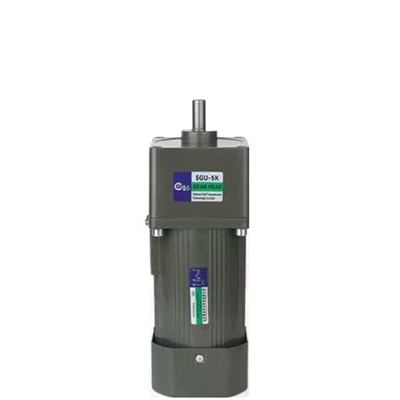
In the realm of industrial and mechanical applications, gear motors play a crucial role in providing the necessary torque and speed control. Among the various types of gear motors available, 400W AC gear motors and DC gear motors are two popular choices. As a supplier of 400W AC Gear Motor, I have witnessed firsthand the unique characteristics and applications of these two types of motors. In this blog post, I will delve into the differences between 400W AC gear motors and DC gear motors, exploring their working principles, performance features, and typical applications.
Working Principles
The fundamental difference between AC and DC gear motors lies in their power sources and how they convert electrical energy into mechanical energy.
AC Gear Motor
An AC gear motor is powered by alternating current (AC), which means the direction of the current flow changes periodically. The most common types of AC motors are induction motors and synchronous motors. In an induction motor, the rotating magnetic field is created by the stator windings, which induces a current in the rotor. This interaction between the magnetic fields of the stator and the rotor causes the rotor to rotate. The gearbox is then used to reduce the speed and increase the torque of the motor output.
The advantage of an AC gear motor is its simplicity and reliability. It can operate directly from the mains power supply without the need for a complex power conversion system. Additionally, AC motors are generally more robust and can withstand harsh environmental conditions.
DC Gear Motor
A DC gear motor, on the other hand, is powered by direct current (DC). The basic principle of a DC motor involves the interaction between a magnetic field and an electric current. The stator of a DC motor creates a stationary magnetic field, while the rotor (armature) carries the current. When the current flows through the armature, a force is generated according to the Lorentz force law, causing the rotor to rotate. The gearbox is also used to adjust the speed and torque of the motor.
DC gear motors offer precise speed control and high starting torque. They can be easily controlled by varying the voltage applied to the motor, which makes them suitable for applications that require accurate speed regulation.
Performance Features
When comparing the performance of 400W AC gear motors and DC gear motors, several key factors need to be considered.


Speed Control
One of the significant differences between AC and DC gear motors is their speed control capabilities. DC gear motors provide excellent speed control over a wide range. By adjusting the voltage applied to the motor, the speed can be precisely regulated. This makes DC gear motors ideal for applications such as conveyor systems, robotics, and precision machinery, where accurate speed control is essential.
In contrast, AC gear motors typically have a fixed speed determined by the frequency of the AC power supply. However, with the use of variable frequency drives (VFDs), the speed of an AC gear motor can be adjusted. VFDs work by changing the frequency and voltage of the AC power supplied to the motor, allowing for a more flexible speed control. Although VFDs add to the cost and complexity of the system, they enable AC gear motors to be used in applications that require variable speed operation.
Torque Characteristics
Torque is another important performance parameter. DC gear motors generally have a high starting torque, which means they can quickly accelerate heavy loads from a standstill. This makes them suitable for applications such as winches, hoists, and automotive seat adjusters.
AC gear motors, especially induction motors, have a relatively lower starting torque compared to DC motors. However, they can provide a constant torque over a wide speed range once they are running. This characteristic makes AC gear motors well - suited for applications such as fans, pumps, and blowers, where a continuous and relatively stable torque is required.
Efficiency
Efficiency is a crucial consideration in any motor application. AC gear motors are often more efficient at full - load operation. They have fewer losses due to the absence of brushes (in the case of induction motors), which reduces friction and wear. Additionally, the design of AC motors allows for better heat dissipation, which helps to maintain high efficiency.
DC gear motors, especially those with brushes, may have lower efficiency due to the friction and electrical losses associated with the brushes. However, brushless DC (BLDC) motors have significantly improved efficiency by eliminating the brushes. BLDC motors use electronic commutation instead of mechanical brushes, which reduces losses and improves overall performance.
Maintenance
Maintenance requirements also differ between AC and DC gear motors. AC gear motors, particularly induction motors, are generally low - maintenance. They have no brushes to wear out, and the simple design of the motor makes it less prone to mechanical failures. This results in lower maintenance costs and longer service life.
DC gear motors with brushes require regular maintenance to replace the brushes as they wear out. The brushes can cause electrical arcing and mechanical wear, which may affect the performance of the motor over time. However, brushless DC motors eliminate this issue, reducing the maintenance requirements.
Typical Applications
The differences in performance and characteristics of 400W AC gear motors and DC gear motors make them suitable for different applications.
AC Gear Motor Applications
- Industrial Fans and Blowers: AC gear motors are commonly used in industrial fans and blowers due to their ability to provide a constant torque at a relatively high speed. They can operate continuously for long periods without overheating, making them ideal for ventilation systems in factories, warehouses, and commercial buildings.
- Pumps: In pumping applications, such as water pumps and hydraulic pumps, AC gear motors are preferred for their reliability and efficiency. They can handle the continuous operation required to move fluids and are often used in water treatment plants, irrigation systems, and HVAC systems.
- Conveyor Systems: For large - scale conveyor systems in industries such as manufacturing, logistics, and mining, AC gear motors can provide the necessary power and torque to move heavy loads over long distances. The use of VFDs allows for variable speed control, which is useful for adjusting the conveyor speed according to the production requirements.
DC Gear Motor Applications
- Robotics: DC gear motors are widely used in robotics due to their precise speed control and high starting torque. They can be used to control the movement of robot arms, joints, and wheels, allowing for accurate and flexible operation.
- Automotive Accessories: In the automotive industry, DC gear motors are used in various applications, such as power windows, windshield wipers, and seat adjusters. Their ability to provide high torque at low speeds makes them suitable for these types of applications.
- Medical Equipment: DC gear motors are also used in medical equipment, such as infusion pumps and surgical robots. The precise speed control and low noise operation of DC motors are essential for these applications, where accuracy and patient comfort are crucial.
Conclusion
In summary, 400W AC gear motors and DC gear motors have distinct differences in their working principles, performance features, and applications. AC gear motors are known for their simplicity, reliability, and efficiency at full - load operation. They are well - suited for applications that require continuous operation and a relatively constant torque. DC gear motors, on the other hand, offer precise speed control and high starting torque, making them ideal for applications that require accurate speed regulation and the ability to start heavy loads.
As a supplier of 400W AC Gear Motor, I understand the importance of choosing the right motor for your specific application. If you are looking for a reliable and cost - effective solution for your industrial or mechanical needs, our 400W AC gear motors are an excellent choice. We also offer 200W AC Gear Motor and 220V AC Gear Motor to meet different power and voltage requirements.
If you have any questions or need further information about our products, please feel free to contact us. We are more than happy to assist you in selecting the most suitable motor for your application and provide you with professional advice and support.
References
- Chapman, S. J. (2012). Electric Machinery Fundamentals. McGraw - Hill.
- Fitzgerald, A. E., Kingsley, C., Jr., & Umans, S. D. (2003). Electric Machinery. McGraw - Hill.
- Krause, P. C., Wasynczuk, O., & Sudhoff, S. D. (2002). Analysis of Electric Machinery and Drive Systems. Wiley - Interscience.