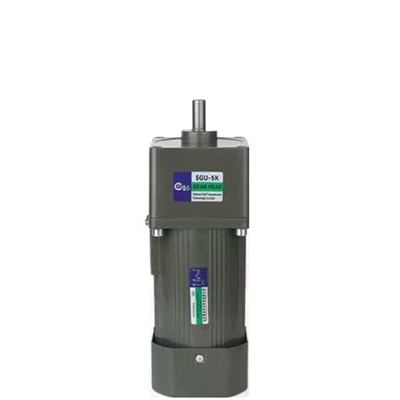
Hey there! As a single phase motor supplier, I often get asked about the acoustic noise level of single phase motors. It's a crucial factor, especially when these motors are used in environments where noise can be a real issue, like in residential areas or quiet offices.
First off, let's understand what causes the noise in a single phase motor. There are several factors at play. One of the main sources is the mechanical vibration. When the motor's rotor spins, it can create vibrations in the motor housing. These vibrations are then transmitted through the air as sound waves. The design of the motor, including the quality of its bearings and the balance of the rotor, can have a big impact on how much vibration is generated. For instance, if the bearings are of poor quality, they might not support the rotor smoothly, leading to more vibrations and, consequently, more noise.
Another source of noise is the electromagnetic forces within the motor. As the electrical current flows through the windings, it creates magnetic fields. These magnetic fields interact with each other and with the motor's components, causing forces that can make the motor vibrate and produce noise. The frequency and intensity of these electromagnetic forces depend on the motor's design, the voltage applied, and the load it's carrying.
Now, let's talk about how we measure the acoustic noise level of a single phase motor. We usually use a unit called decibels (dB). Decibels are a logarithmic scale that measures the intensity of sound. A lower dB value means less noise. In the case of single phase motors, the noise level can vary widely depending on the motor's size, power rating, and application.


Smaller single phase motors, like those used in household appliances such as fans or small pumps, typically have a lower noise level. They might operate at around 40 - 60 dB, which is about as loud as a normal conversation or a quiet office environment. These motors are designed to be relatively quiet so as not to disturb the people around them.
On the other hand, larger single phase motors, like those used in industrial applications or heavy - duty equipment, can be much louder. They can reach noise levels of 70 - 90 dB or even higher. At 70 dB, it's about as loud as a vacuum cleaner, and at 90 dB, it's comparable to a lawnmower. Prolonged exposure to noise levels above 85 dB can be harmful to human hearing, so it's important to take appropriate measures to reduce the noise in these situations.
As a single phase motor supplier, we offer a variety of motors with different noise levels to meet our customers' needs. For example, our YL Series Single Phase Motor is designed to be energy - efficient and relatively quiet. It's suitable for applications where noise is a concern, such as in small workshops or home - based businesses.
Our 220 Volt Single Phase Motor is another popular option. It can operate at different power levels, and we've taken steps in the design to minimize the noise. Whether you're using it for a small conveyor system or a water pump, you can expect a reasonable noise level.
The ML Series Single Phase Motor is also a great choice. It's built with high - quality components that help reduce vibration and noise. This series is often used in applications where reliability and low noise are essential, like in medical equipment or precision machinery.
If you're worried about the noise level of a single phase motor in your specific application, there are some things you can do to reduce it. One option is to use vibration - isolation mounts. These mounts can absorb the vibrations from the motor and prevent them from being transmitted to the surrounding structure. Another option is to enclose the motor in a sound - proof enclosure. This can significantly reduce the amount of noise that escapes into the environment.
We also offer technical support to our customers. Our team of experts can help you select the right motor with the appropriate noise level for your application. We can also provide advice on how to install the motor to minimize noise.
In conclusion, the acoustic noise level of a single phase motor is an important consideration. It depends on various factors such as the motor's size, design, and application. As a single phase motor supplier, we're committed to providing motors with different noise levels to meet your specific needs. Whether you need a quiet motor for a residential application or a more powerful one for an industrial setting, we've got you covered.
If you're interested in our single phase motors or have any questions about the acoustic noise level, feel free to reach out to us. We're more than happy to discuss your requirements and help you find the perfect motor for your project. Let's start a conversation and see how we can work together to solve your motor needs.
References
- "Electric Motors and Drives: Fundamentals, Types and Applications" by Austin Hughes and Bill Drury
- "Motor Noise: Sources, Measurement, and Reduction" - Industry white paper on motor noise analysis.