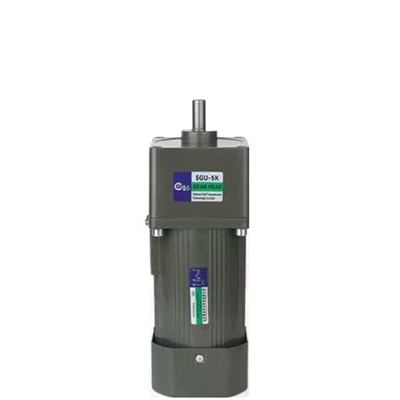
What are the requirements for a 400W AC Gear Motor used in a lifting device?
When it comes to using a 400W AC Gear Motor in a lifting device, there are several critical requirements that need to be met to ensure optimal performance, safety, and longevity. As a supplier of 400W AC Gear Motor, I understand the importance of these factors and am here to share some insights.
Power and Torque Requirements
The first and foremost requirement is the power and torque output of the motor. A 400W AC Gear Motor is designed to provide a certain amount of power, but the torque requirements for a lifting device can vary significantly depending on the load, lifting speed, and mechanical efficiency of the system.


The torque needed to lift a load is calculated based on the weight of the load, the radius of the lifting mechanism (such as a pulley or a drum), and the acceleration and deceleration requirements. For example, if you are lifting a heavy load slowly, you may need a motor with high torque at low speeds. On the other hand, if you need to lift the load quickly, the motor should be able to provide sufficient power to accelerate the load rapidly.
In general, a 400W AC Gear Motor can provide a decent amount of torque, but it is essential to ensure that the motor's torque - speed curve matches the requirements of the lifting device. Some applications may require a Gear Reduction Motor to increase the torque output at the expense of speed.
Speed and Control
The speed of the motor is another crucial factor. The lifting speed of the device depends on the rotational speed of the motor and the mechanical transmission ratio. For most lifting applications, a variable speed control is desirable to allow for precise positioning and adjustment of the lifting speed.
AC Gear Motors can be controlled using various methods, such as variable frequency drives (VFDs) or phase - control methods. VFDs are more precise and efficient, allowing for smooth speed control over a wide range. They also offer features like soft - start and soft - stop, which can reduce mechanical stress on the lifting device and the motor.
When selecting a 400W AC Gear Motor for a lifting device, it is important to consider the maximum and minimum speed requirements. For example, if the lifting device needs to operate in a confined space, a lower speed may be required for better control. Conversely, if the lifting operation needs to be completed quickly, a higher speed may be necessary.
Efficiency and Heat Dissipation
Efficiency is an important consideration for any motor, especially in a lifting device that may operate for extended periods. A more efficient motor will consume less power, resulting in lower energy costs and reduced heat generation.
Heat dissipation is also critical for the longevity of the motor. A 400W AC Gear Motor will generate heat during operation, and if this heat is not dissipated effectively, it can lead to premature failure of the motor components. To ensure proper heat dissipation, the motor should be designed with adequate ventilation and cooling mechanisms.
Some motors are equipped with cooling fans or heat sinks to improve heat transfer. Additionally, the choice of materials and the design of the motor housing can also affect heat dissipation. For example, motors with aluminum housings tend to have better heat dissipation properties than those with plastic housings.
Durability and Reliability
Lifting devices are often used in demanding environments, and the motor needs to be durable and reliable. The motor should be able to withstand mechanical shocks, vibrations, and dust, as well as temperature and humidity variations.
The quality of the motor's components, such as the gears, bearings, and windings, is crucial for its durability. High - quality gears are less likely to wear out quickly, and good - quality bearings will reduce friction and ensure smooth operation. The motor windings should be insulated properly to prevent short - circuits and other electrical failures.
In addition, the motor should be designed with overload protection to prevent damage in case of excessive load. This can be achieved through thermal overload relays or electronic protection circuits.
Safety Features
Safety is of utmost importance in any lifting application. The 400W AC Gear Motor should be equipped with safety features to protect the operator and the equipment.
One of the essential safety features is the braking system. A reliable brake is needed to hold the load in place when the motor is stopped or in case of a power failure. There are different types of brakes available, such as electromagnetic brakes and mechanical brakes. Electromagnetic brakes are more common in AC Gear Motors as they can be easily controlled and provide quick and reliable stopping.
Another safety feature is the motor's protection against electrical faults, such as short - circuits and over - voltage. This can be achieved through the use of fuses, circuit breakers, and surge protectors.
Compatibility with the Lifting Device
The 400W AC Gear Motor should be compatible with the mechanical and electrical systems of the lifting device. This includes the mounting dimensions, shaft size, and coupling requirements.
The motor should be easy to install and integrate into the lifting device. It is important to ensure that the motor's shaft can be properly coupled to the lifting mechanism, such as a pulley or a gearbox. The mounting holes and the overall dimensions of the motor should match the available space in the lifting device.
In terms of electrical compatibility, the motor should be designed to operate at the same voltage and frequency as the power supply of the lifting device. Additionally, the motor's control system should be compatible with the overall control system of the lifting device.
Cost - Effectiveness
Finally, cost - effectiveness is an important factor when selecting a 400W AC Gear Motor for a lifting device. While it is important to choose a motor that meets all the technical requirements, it is also necessary to consider the cost of the motor, including the purchase price, installation cost, and maintenance cost.
In some cases, a more expensive motor may offer better performance, efficiency, and reliability, which can result in lower long - term costs. However, it is also possible to find a cost - effective motor that meets the basic requirements of the lifting device. When comparing different motors, it is important to consider the total cost of ownership rather than just the initial purchase price.
Conclusion
In conclusion, a 400W AC Gear Motor used in a lifting device needs to meet a variety of requirements, including power and torque, speed and control, efficiency and heat dissipation, durability and reliability, safety features, compatibility, and cost - effectiveness. As a supplier of 400W AC Gear Motor, we can provide you with motors that meet these requirements and offer customized solutions based on your specific lifting application.
If you are in the market for a 400W AC Gear Motor for your lifting device, or if you have any questions about the requirements or our products, please feel free to contact us. We are more than happy to assist you in finding the right motor for your needs and to discuss the details of your procurement. We also offer a range of related products, such as Gear Reduction Motor and 200W AC Gear Motor, which may be suitable for different applications.
References
- "Electric Motors and Drives: Fundamentals, Types, and Applications" by Austin Hughes and Bill Drury.
- "Motor Handbook" by Arnold Tustin.
- Technical documents from leading motor manufacturers.