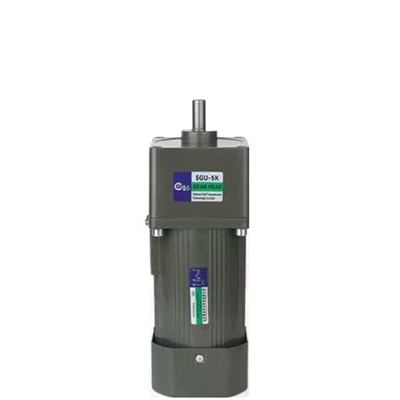
Hey there! As a supplier of 400W AC Gear Motors, I often get asked about the cold-resistant requirements for these motors when they're used in low-temperature environments. So, I thought I'd share some insights on this topic.
First off, let's understand why cold resistance matters. In low-temperature settings, a motor can face a bunch of challenges. The most obvious one is the impact on the lubricants. Lubricants are crucial for reducing friction and wear between moving parts in a gear motor. When it gets cold, the viscosity of the lubricant increases. That means it becomes thicker and doesn't flow as easily. As a result, the motor has to work harder to overcome the increased resistance, which can lead to higher energy consumption and even premature wear and tear.
Another issue is the effect on the electrical components. Cold temperatures can cause the insulation materials to become brittle. This makes them more prone to cracking, which can lead to electrical shorts and other malfunctions. Also, the performance of the motor's windings can be affected. The resistance of the copper windings may change with temperature, which can impact the motor's efficiency and torque output.
So, what are the specific cold-resistant requirements for a 400W AC Gear Motor?


Lubrication
The lubricant used in the gear motor is a key factor. You need a lubricant that can maintain its fluidity at low temperatures. Synthetic lubricants are often a great choice. They have better low-temperature performance compared to mineral-based lubricants. Synthetic lubricants can remain fluid at much lower temperatures, ensuring smooth operation of the gears. For example, some high-quality synthetic lubricants can still function properly at temperatures as low as -40°C. When choosing a lubricant, make sure to check its viscosity-temperature characteristics. You want a lubricant that has a relatively stable viscosity over a wide range of temperatures.
Insulation Materials
The insulation materials in the motor also need to be cold-resistant. Class F or Class H insulation is commonly used in motors designed for low-temperature environments. These insulation classes can withstand lower temperatures without becoming brittle. Class F insulation can typically handle temperatures down to -20°C, while Class H insulation can go even lower, around -40°C. Additionally, the insulation should have good moisture resistance. In cold environments, moisture can condense on the motor's components, and if the insulation isn't moisture-resistant, it can lead to corrosion and electrical problems.
Design Considerations
The design of the motor itself plays a role in its cold resistance. A well-designed motor will have proper ventilation and heat dissipation mechanisms. In cold environments, it's important to prevent the motor from overheating during operation, but also to ensure that it doesn't cool down too quickly when it's not running. Some motors are designed with additional insulation layers to help maintain a stable internal temperature. The gearbox design also matters. A sealed gearbox can prevent moisture and cold air from entering, protecting the gears and lubricant.
Testing and Certification
Before using a 400W AC Gear Motor in a low-temperature environment, it's essential to test it under simulated cold conditions. This can help identify any potential issues and ensure that the motor meets the required cold-resistant standards. Look for motors that have been tested and certified for low-temperature operation. Certifications from recognized organizations can give you confidence in the motor's performance.
Now, let's talk about some of the related products we offer. If you're interested in a 220V AC Gear Motor, you can check out our 220V AC Gear Motor page. We also have a wide range of Gear Reduction Motor options, which can provide different levels of speed reduction and torque output. And for those who need a more specialized solution, our Worm Gear Reduction Motor might be a great fit.
If you're in the market for a 400W AC Gear Motor for a low-temperature environment, we're here to help. We have the expertise and experience to provide you with a motor that meets your specific cold-resistant requirements. Whether you're in the food processing industry, where motors are often exposed to cold storage conditions, or in the outdoor equipment sector, we can offer a reliable solution.
Don't hesitate to reach out to us if you have any questions or if you're ready to discuss your procurement needs. We're always happy to have a chat and find the best motor for your application.
References
- "Motor Handbook" - A comprehensive guide on motor design and performance.
- Industry standards on low-temperature motor operation from relevant organizations.