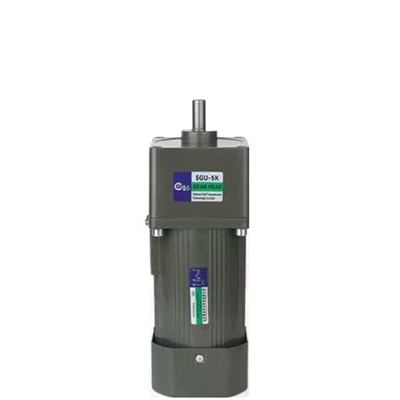
Hey there! As a supplier of 400W AC Gear Motors, I often get asked about how to select the right coupling for these motors. It's a crucial decision as the coupling plays a vital role in ensuring the smooth operation and longevity of your motor system. So, in this blog post, I'll share some tips and considerations to help you make the best choice.
First off, let's talk about what a coupling does. A coupling is a mechanical device that connects two shafts together, allowing them to transmit power from one to the other. In the case of a 400W AC Gear Motor, the coupling connects the motor shaft to the driven shaft of whatever equipment you're using, like a conveyor belt, a pump, or a mixer. It helps to compensate for any misalignment between the two shafts, reduce vibration, and protect the motor and the driven equipment from damage.
Now, when it comes to selecting a coupling for your 400W AC Gear Motor, there are several factors you need to consider.
Torque Requirements
The first thing you need to look at is the torque requirements of your application. Torque is the rotational force that the motor needs to generate to drive the load. You need to make sure that the coupling you choose can handle the maximum torque that the motor will produce. If the coupling can't handle the torque, it may fail, leading to downtime and costly repairs.
To determine the torque requirements, you need to know the power rating of your 400W AC Gear Motor and the speed at which it will operate. You can use the following formula to calculate the torque:


Torque (in Nm) = (Power in Watts x 9.55) / Speed in RPM
For example, if your motor has a power rating of 400W and operates at 1500 RPM, the torque would be:
Torque = (400 x 9.55) / 1500 ≈ 2.55 Nm
Once you've calculated the torque, you can choose a coupling that has a torque rating equal to or higher than your calculated value.
Shaft Sizes
Another important factor is the shaft sizes of the motor and the driven equipment. The coupling needs to have the right bore sizes to fit snugly onto the shafts. You need to measure the diameter of the motor shaft and the driven shaft accurately. Most couplings come in a range of bore sizes, so you should be able to find one that matches your shaft sizes.
Misalignment Tolerance
In real-world applications, it's almost impossible to have perfect alignment between the motor shaft and the driven shaft. There will always be some degree of misalignment, whether it's angular, parallel, or axial. The coupling you choose needs to be able to tolerate this misalignment without causing excessive stress on the shafts or the coupling itself.
There are different types of couplings with varying degrees of misalignment tolerance. For example, flexible couplings are designed to accommodate a certain amount of misalignment. They use flexible elements like rubber or metal bellows to absorb the misalignment and reduce vibration. Rigid couplings, on the other hand, are not suitable for applications with significant misalignment as they can transmit the misalignment forces to the shafts, leading to premature wear and failure.
Operating Environment
The operating environment also plays a role in coupling selection. If your application is in a harsh environment, such as a high-temperature, high-humidity, or corrosive environment, you need to choose a coupling that can withstand these conditions. For example, some couplings are made from materials that are resistant to corrosion, like stainless steel or aluminum. Others have special coatings or seals to protect them from dust, dirt, and moisture.
Types of Couplings
There are several types of couplings available in the market, each with its own advantages and disadvantages. Here are some of the most common types:
Flexible Couplings
- Elastomeric Couplings: These couplings use an elastomeric element, such as rubber or polyurethane, to transmit torque and accommodate misalignment. They are relatively inexpensive, easy to install, and can dampen vibration. However, they have a limited torque capacity and may need to be replaced periodically due to wear of the elastomeric element.
- Jaw Couplings: Jaw couplings consist of two hubs with jaws and an elastomeric spider in between. The spider absorbs misalignment and provides some vibration damping. They are commonly used in general-purpose applications and can handle moderate torque.
- Bellows Couplings: Bellows couplings are made of a thin-walled metal bellows that allows for angular, parallel, and axial misalignment. They have a high torque capacity and are suitable for high-speed applications. However, they are more expensive than other types of flexible couplings.
Rigid Couplings
- Sleeve Couplings: Sleeve couplings are simple and inexpensive. They consist of a sleeve that is mounted on the two shafts and held in place by set screws or keys. They are suitable for applications where there is little or no misalignment.
- Flange Couplings: Flange couplings are more robust than sleeve couplings. They have flanges on each end that are bolted together. They can handle higher torque and are often used in heavy-duty applications.
Cost
Of course, cost is also a consideration. You want to get a coupling that meets your requirements without breaking the bank. However, it's important not to compromise on quality for the sake of saving a few bucks. A cheap, low-quality coupling may end up costing you more in the long run due to frequent replacements and downtime.
Where to Find the Right Coupling
As a 400W AC Gear Motor supplier, I can offer some guidance on coupling selection. We have a wide range of Gear Reduction Motor options, including Worm Gear Reduction Motor and 200W AC Gear Motor. Our team of experts can help you choose the right coupling based on your specific application requirements.
If you're still not sure which coupling is right for your 400W AC Gear Motor, don't hesitate to reach out. We're here to help you make the best decision and ensure that your motor system operates smoothly and efficiently. Whether you're a small business owner or a large industrial manufacturer, we can provide you with the products and support you need.
In conclusion, selecting the right coupling for your 400W AC Gear Motor is a critical decision that requires careful consideration of factors such as torque requirements, shaft sizes, misalignment tolerance, operating environment, and cost. By taking the time to evaluate these factors and choosing the appropriate coupling, you can ensure the reliability and performance of your motor system. So, if you're in the market for a coupling or have any questions about our 400W AC Gear Motors, feel free to contact us for a detailed discussion and to start the procurement process.
References
- "Mechanical Power Transmission Handbook" by Heinz P. Bloch and Fred K. Geitner
- "Machinery's Handbook" by Industrial Press Inc.